Quick answer: use summer to keep taught phonics usable, not to race ahead
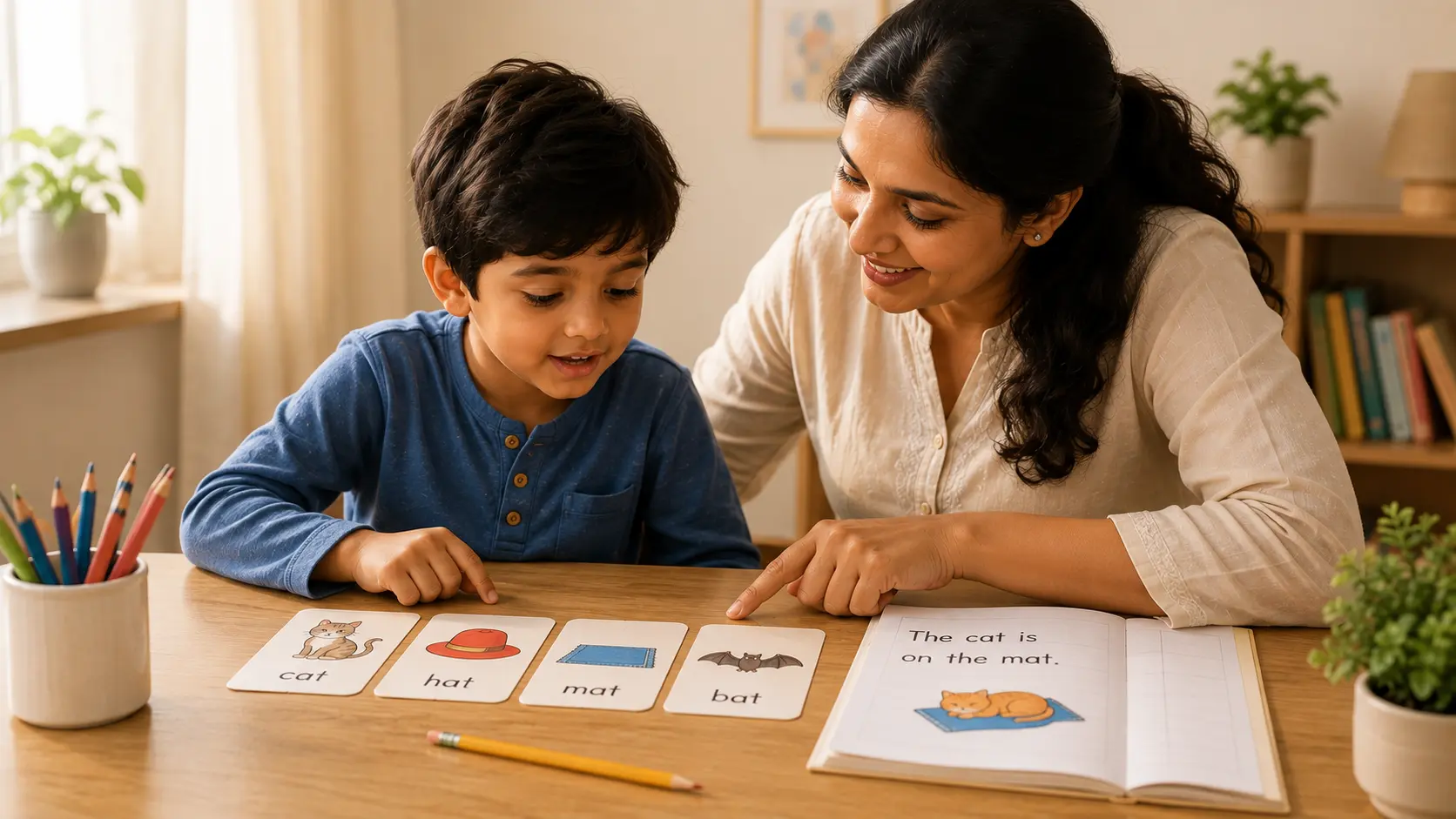
If your child is still actively learning phonics, summer practice can be very simple: choose **one current sound or spelling pattern**, retrieve it from memory, use it to decode a few suitable words, spell one or two words, and then carry the same knowledge into a short sentence or decodable text. The aim is to keep the taught code usable with less prompting—not to cover the next term’s curriculum early.
The “10-minute” routine in this article is a practical container for busy families, **not a research-proven minimum dose** and not a promise that ten minutes a day will prevent every reading difficulty. If five focused minutes is enough for a young child, use five. If the child is engaged and needs a little longer to finish a short text, that is also reasonable.
This article is deliberately narrower than How to Prevent the Summer Slide in Reading. That guide covers summer reading maintenance from pre-reading through fluent reading and comprehension. This page is specifically for a child who still has an **active phonics learning target** and needs light practice during a school break.
Who this summer phonics plan is for—and who needs a different plan
- A beginning reader who is still securing letter–sound correspondences and early blending.
- A developing decoder who is practising CVC words, digraphs, vowel patterns or another currently taught phonics feature.
- A child whose teacher or phonics programme has identified one or two patterns that need more retrieval and transfer practice.
If your child already reads age-appropriate text accurately and phonics is no longer the main bottleneck, do not force a daily phonics drill simply because it is summer. Use broader reading, vocabulary, fluency and comprehension instead. If your child has never had a clear phonics sequence, start with the appropriate foundational guide rather than selecting random summer rules from the internet.
Ten minutes is a structure, not a mastery rule
Parents often want a precise daily number because it makes routines easier to organise. That is useful operationally, but the clock does not tell you whether learning transferred. A child can spend ten minutes tapping answers in a game and show little change in printed-word reading; another child may need only a few well-chosen examples to retrieve a pattern and apply it independently.
So use time to **protect the routine**, not to define mastery. The stronger evidence is whether the child can recall the taught correspondence, decode a fresh suitable word, spell from sound and use the same pattern in connected text with decreasing help.
First choose one current phonics target
Do not build a summer session by asking, “Which fun worksheet shall we do today?” Start with the learning target. A useful target is narrow enough that you can see whether the child is actually retrieving and applying it.
- **Sound recall target:** one small set of taught grapheme–phoneme correspondences that are still inconsistent.
- **Blending target:** joining known sounds through a short word without guessing from the first letter or picture.
- **Pattern target:** one already-taught digraph, vowel pattern or r-controlled pattern that needs consolidation.
- **Spelling target:** segmenting a word and mapping the heard phonemes back to the graphemes already taught.
If the main issue is that your child knows individual sounds but cannot combine them into words, use How Kids Learn Blending and Phonics Blending Activities rather than adding more patterns. If CVC decoding is the current milestone, CVC Words Explained for Parents owns that foundation.
The Tiny Steps five-part summer phonics loop
For summer home practice, Tiny Steps uses a simple editorial loop: **Retrieve → Decode → Encode → Transfer → Adjust**. It is not a standardized assessment. It is a way to stop an activity from becoming disconnected from the reading skill it is supposed to practise.
- **Retrieve:** show the taught grapheme or pattern and ask for the sound without giving a picture clue.
- **Decode:** read a few words that genuinely use the taught code and do not require untaught patterns.
- **Encode:** say one or two words aloud and let the child segment the sounds and spell using known graphemes.
- **Transfer:** read the same target inside a fresh sentence, caption or short decodable passage.
- **Adjust:** if transfer collapses, reduce difficulty and reteach the same target rather than automatically adding a new rule.
This same skill-first principle is used in our broader Phonics Activities at Home guide. That article owns the year-round home-routine question; this one adapts the idea specifically for a lighter school-break context.
A flexible 10-minute summer phonics routine
Use the following as a shape, not a stopwatch. If one part is already easy, shorten it. If a child needs a little more modelling on one word, slow down rather than racing to complete every box.
- **About 2 minutes — retrieve:** review a small set of already-taught sounds or one target spelling pattern in mixed order.
- **About 3 minutes — decode:** read two to five carefully chosen words using that target. Include at least one fresh example the child has not just memorised.
- **About 2 minutes — encode:** say one or two suitable words and let the child segment and spell them.
- **About 2 minutes — transfer:** read one short sentence, caption or tiny decodable passage containing the same target.
- **About 1 minute — adjust and finish:** note one useful observation—“needed help blending”, “read fresh word independently”, “spelling still missed the digraph”—and stop on a manageable success.
There is no need to hit the same word count every day. Two well-chosen words can be more informative than a ten-word list that the child rushes through or remembers by position.
Choose the right version for your child’s current phonics stage
Version A — sound recall and first blending
Use a very small set of taught single-letter correspondences. Retrieve the sounds, build one or two decodable CVC words, model left-to-right blending and finish with one tiny line if the child is ready. SATPIN at Home gives a detailed launch routine for a child at this stage.
Version B — short-word decoding and digraphs
Choose one secure or recently taught pattern such as sh, ch or another programme-aligned digraph. Decode a few words containing that pattern, spell one from sound and read a sentence where the target appears naturally. Do not combine several new digraphs just to make the session feel varied.
Version C — later phonics patterns
For a child working on long vowels, r-controlled vowels or longer words, keep the same loop but use material from the child’s actual teaching sequence. Route specific practice to Long Vowel Practice for Kids, R-Controlled Vowel Practice or Multisyllabic Word Practice rather than turning this summer routine into a catalogue of every phonics rule.
A weekly rhythm without a new-pattern quota
The old version of this article suggested scheduled “new digraph” and “new long vowel” days. That is not a safe universal home plan because children follow different sequences and may not be ready for those patterns. A better weekly rhythm keeps the **target stable long enough to observe transfer**.
- **Practice day:** retrieve and decode the current target.
- **Spelling day:** use the same target in segmenting and encoding.
- **Text day:** read the target in a short matched sentence or passage.
- **Fresh-check day:** try one or two new suitable words to see whether the pattern transfers beyond rehearsed examples.
- **Choice day or rest day:** use a favourite appropriate activity, shared reading or simply take a break.
Families do not need five formal phonics sessions every week. The point is to vary the **way the same knowledge is used** before assuming the child needs another pattern.
Games can support the routine—but transfer is the check
A phonics game is useful when the reading skill remains visible. If the child wins mainly by reacting to animation, memorising screen positions or using picture clues, the score says little about printed-word reading.
- **Letter-sound game:** after the game, show the same grapheme on a plain card and ask for the sound.
- **Blending game:** after the game, ask the child to read one fresh word using the same taught correspondences.
- **Spelling game:** say one new suitable word off-screen and ask the child to segment and build it.
Online Phonics Games for Kids owns the full question of whether a digital game genuinely supports reading transfer. Phonics Games for Letter Sounds owns the practical letter-sound game routine.
Tiny Steps Balloon Pop can be used as a brief sound-recall warm-up because its core task is **hear sound → identify printed letter → choose the correct balloon**. It should not be treated as evidence that a child can blend or read words. Use an off-screen word or sentence to check the next reading step.
How to choose decodable practice text for summer
For a beginning decoder, the practice text should mainly use grapheme–phoneme correspondences and word structures the child has already been taught. “Predictable” is not the same as “decodable”: a repeated sentence frame may be easy to guess even when the printed code is beyond the child.
- Check whether the child has been taught the main sound–spelling patterns in the text.
- Keep the passage short enough that decoding remains accurate and meaning is not lost in fatigue.
- After decoding, ask one simple meaning question so phonics practice remains connected to real reading.
Rich storybooks still belong in summer. Read them aloud, discuss vocabulary and enjoy them together even when the child cannot independently decode every word. Decodable practice text and rich shared reading serve different purposes.
The Tiny Steps summer carryover check
Once in a while, check whether the target survives outside the exact activity. Tiny Steps uses four observable questions: **Recall → Fresh word → Spelling → Text**.
- **Recall:** Can the child retrieve the target sound or spelling without the game, picture or worksheet prompt?
- **Fresh word:** Can the child decode an unfamiliar but appropriate word containing the target?
- **Spelling:** Can the child hear the phonemes and represent the target correctly in a suitable spoken word?
- **Text:** Can the child use the same knowledge inside a short sentence or passage?
This is an editorial observation framework, not a standardized mastery test. One mistake does not mean a child has “lost” the pattern. Look for whether independence is broadly increasing and whether the same error repeats across appropriate examples.
What to do when a child resists summer phonics
First check the task before blaming motivation. Resistance often increases when the material is too difficult, too repetitive, too long or disconnected from what the child has actually been taught. Reduce the number of examples, offer a choice between two appropriate formats, or alternate one decoding task with a shared-reading activity.
Praise the process you want repeated: “You looked through the whole word,” “You fixed the middle sound,” or “You heard all three sounds before spelling.” Avoid turning every session into a speed competition. Accuracy and usable transfer matter before faster performance.
When to stop summer phonics and just read
A child does not need permanent phonics practice. If the currently taught patterns are secure enough for accurate, increasingly automatic word reading and the main difficulty has shifted to fluency, vocabulary or comprehension, move the emphasis accordingly.
If word reading is accurate but slow, use How to Improve Reading Fluency in Children. If the child reads the words but does not understand the text, use From Decoding to Comprehension or the dedicated comprehension diagnostic guide. Summer practice should follow the current bottleneck, not preserve a phonics drill after it has stopped being the main need.
When home summer practice is not enough
Ask for teacher guidance if the child repeatedly cannot retrieve correspondences that were previously well taught, cannot blend suitable words despite modelling, guesses instead of attending through print, or cannot transfer a practised pattern into fresh words and matched text. The useful next step is to identify the instructional bottleneck, not simply increase the number of summer worksheets.
This article cannot diagnose dyslexia, hearing, speech, language, attention or another learning condition. Persistent difficulty or broader developmental concerns should be discussed with an appropriately qualified teacher or relevant professional.
Evidence and references
The evidence supports explicit, systematic phonics, cumulative practice, decoding, spelling and connected-text application. It does **not** establish one universal summer schedule, one required daily minute count or one fixed number of words that proves mastery. The 10-minute routine and Tiny Steps observation loops in this article are practical editorial frameworks built around those evidence-aligned principles.
- Education Endowment Foundation — Phonics: evidence summary supporting explicit, systematic phonics and matching teaching to pupils’ current phonemic awareness and grapheme knowledge. https://educationendowmentfoundation.org.uk/education-evidence/teaching-learning-toolkit/phonics
- Institute of Education Sciences / What Works Clearinghouse — Foundational Skills to Support Reading for Understanding in Kindergarten Through 3rd Grade: recommends teaching sound–spelling relationships, decoding, word analysis, writing and connected-text reading. https://ies.ed.gov/ncee/wwc/Docs/practiceGuide/wwc_foundationalreading_040717.pdf
- Institute of Education Sciences — Supporting Your Child’s Reading at Home: family-facing resources for practising foundational reading skills and applying sound–spelling knowledge in words and text. https://ies.ed.gov/ncee/edlabs/regions/southeast/foundations/kindergarten_intro.asp
- UK Department for Education — The Reading Framework: guidance on systematic synthetic phonics, cumulative progression, blending, spelling and practice in matched books. Outside England, these documents are useful implementation references rather than rules. https://www.gov.uk/government/publications/the-reading-framework-teaching-the-foundations-of-literacy
Useful next steps
- Use the broader summer reading plan if your child’s main need is no longer phonics.
- Use the year-round home phonics routine if you need a sustainable practice system beyond the summer break.
- Use the blending progression guide if sound knowledge is present but words still do not come together.
- Read how phonics supports spelling if encoding is the weaker transfer step.
- Explore the Tiny Steps phonics programme if your child needs guided sequencing, feedback and teacher observation.
FAQs
Parent guide: how to use this weekly plan in real life
Use this weekly post as a practical checklist, not a one-time read. Keep routines short, repeat the same target for 5-7 days, and track one visible win.
- Choose one daily slot and keep it fixed (same time, same place).
- Do 10-15 focused minutes only; stop while your child still feels successful.
- Use one correction script: "Let us try slowly, then fast."
- Send one weekly note to the teacher: what improved, what still needs support.
Research basis: why this weekly plan works
This weekly structure reflects evidence-aligned classroom practice used in early literacy and communication instruction: explicit teaching, short retrieval cycles, and repeated guided practice with feedback.
- Distributed practice beats cramming: short sessions across the week improve retention better than one long session.
- Retrieval and correction loops build fluency: recall first, then immediate gentle correction, then one successful retry.
- Clear success criteria improve motivation: children engage better when the goal is visible and achievable in one session.
Tiny Steps quality standard for this week
Every Tiny Steps weekly blog should give parents a usable routine, measurable progress signal, and practical fallback when the child gets stuck. Use this page as a field guide, not theory-only reading.
- One concrete routine parents can run in 10-15 minutes.
- One measurable checkpoint (accuracy, fluency, or confidence) by week-end.
- One rescue strategy for low-motivation days so consistency does not break.
Real-world action plan: summer phonics without learning loss
A light, repeatable summer routine protects reading accuracy and confidence better than irregular intensive sessions.
10-minute at-home routine (realistic for busy parents)
- Follow 4-day cycle: sound review, blending, decodable reading, spelling dictation.
- Use travel-friendly materials: 20 word cards, one notebook, one timer.
- Keep a weekly scorecard: words read correctly, words spelled correctly, confidence level.
If your child gets stuck
If routine breaks during travel, run a 5-minute oral-only session in car or at bedtime and resume full practice next day.
End-of-week success signs
- Child maintains reading level across holiday weeks.
- Child retains core phonics patterns already taught.
- Parent can identify exactly which pattern needs revision after breaks.
Parents also ask this week
- Can I skip practice on vacation? Skip occasionally, but keep at least 4 sessions per week.
- What is minimum summer workload? Ten minutes daily or 40-50 minutes spread across the week.