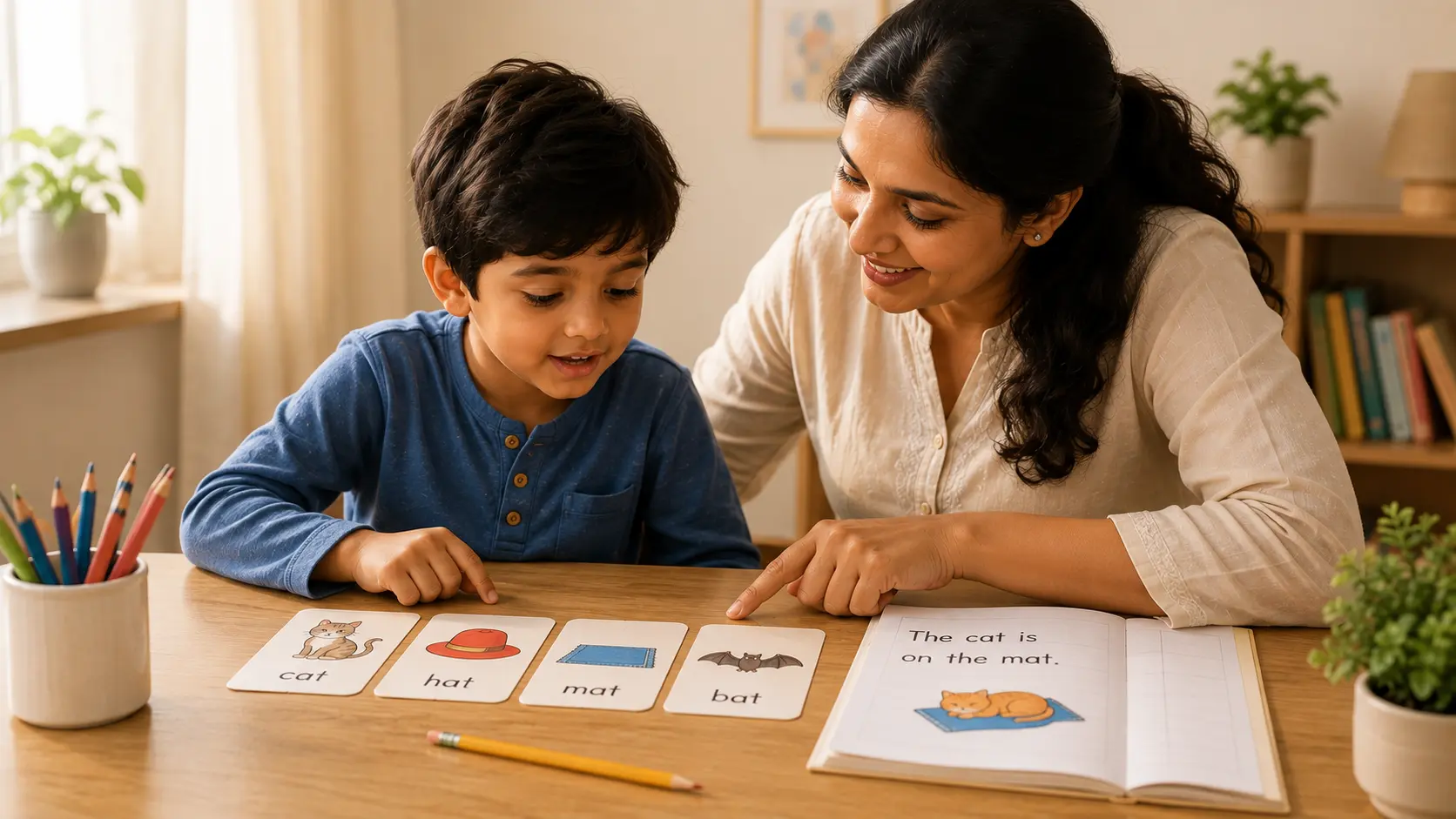
Quick answer: how can parents reduce summer reading loss?
Keep reading active through a small, repeatable routine that matches your child’s current stage. For an early reader, that may mean sound review, blending and a short decodable text. For a more fluent reader, it may mean reading a short passage, discussing one new word and giving a brief retell. Ten minutes is a practical home container, not a research-proven minimum dose or a guarantee that every child will maintain the same reading level.
The useful goal is continuity: give the child regular chances to decode, read with increasing ease, understand what was read and talk about it. If ten focused minutes fits your family, use ten. If five good minutes is more realistic, start there and protect the habit. The clock protects a manageable routine; it does not define mastery.
What “summer slide” actually means — and what it does not mean
“Summer slide” or summer learning loss describes an average pattern in which some children’s academic test scores flatten or decline while school is out. Reading patterns vary considerably: not every child loses reading skill, different assessments show different amounts of change, and some children maintain or grow. Summer slide is not a diagnosis or an individual forecast. A parent should not assume that a child will automatically “lose months of reading” simply because there is a school holiday.
A better home question is: “Which reading processes does my child still need to use regularly?” For a beginning reader, that may be phoneme awareness, sound-letter recall and blending. For a developing reader, it may be accurate word reading and fluency. For an increasingly fluent reader, vocabulary, comprehension and summarising may deserve more attention.
Summer reading plan vs summer phonics plan: choose the right guide
This guide covers broad summer reading maintenance across reading stages: decoding, fluency, vocabulary, comprehension, discussion and reading for pleasure. If your child still has a specific active phonics target — for example, consolidating CVC blending, a taught digraph or another sound-spelling pattern — use our Summer Phonics Practice for Kids: A 10-Minute Daily Routine. That narrower guide owns phonics-target practice rather than whole-reading maintenance.
You do not need to run both plans in full. Choose the one that matches the main bottleneck, and borrow one useful element from the other only when the child’s reading evidence calls for it.
Who this plan is for
- Parents or guardians who want a light reading routine during a long school break.
- Teachers or tutors who want a simple home-practice structure to share with families.
- Children who already have some stage-appropriate reading instruction and need continuity, not an accelerated crash course.
If your child has not yet started reading printed words, use the pre-reader version below instead of forcing a passage-reading routine. If reading is already persistently difficult during the school term, summer practice can support the child but should not replace appropriate teacher or specialist assessment.
Choose the right 10-minute routine by reading stage
The splits below are examples of how a short session can be shaped. They are not required minute-by-minute prescriptions. Keep the useful parts, shorten what is tiring, and spend longer on the component that actually needs support.
Stage A — pre-reader or very early phonics learner
- Briefly play with spoken sounds: rhyme, first sounds or simple oral blending.
- Review only the letter-sound correspondences already taught.
- Blend a small number of simple words if the child knows enough sounds to build them.
- Finish with a picture book or short read-aloud and talk about one idea or new word.
Do not measure a pre-reader by how many pages they finish. At this stage, useful progress is cleaner sound awareness, more reliable sound-letter recall, early blending and richer oral language.
Stage B — developing decoder who can read short words and sentences
- Briefly review one phonics pattern that still needs practice.
- Read a short decodable or appropriately controlled passage aloud.
- Reread one sentence or short section with feedback for accuracy and phrasing.
- Ask one meaning question and let the child retell one important idea.
If the child spends most of the passage guessing or needs help on nearly every line, the text is not serving the routine. Reduce the text difficulty or return to the specific decoding pattern that is breaking down.
Stage C — increasingly fluent reader
- Read a short passage or a section of a chosen book.
- Discuss one unfamiliar word using the sentence context and a child-friendly explanation.
- Ask one “why”, “how” or inference question rather than only recalling facts.
- Finish with a short spoken summary: “This part was mainly about…”
Older or fluent readers do not need a compulsory phonics drill simply because it is summer. Use phonics or word-analysis practice only when decoding evidence shows that it is still needed.
The Tiny Steps summer loop: Decode → Reread → Understand → Talk
Across the stages, keep four reading behaviours connected. Decode means account for the print rather than guess. Reread means revisit a useful line or section so word reading becomes easier and phrasing can improve. Understand means recover the message rather than finish the words without meaning. Talk means explain, retell, predict or discuss one idea in the text.
This is a Tiny Steps editorial teaching framework, not a standardized assessment protocol. A pre-reader may spend more time on oral language and early sound work; a fluent reader may spend almost all of the routine in connected text. The framework helps parents remember that successful reading is more than page completion.
How to choose a book or passage that helps instead of frustrates
- The child should be able to read enough of the text to keep the meaning in mind rather than stopping at almost every word.
- A few unfamiliar words are useful if the child can still follow the passage with manageable support.
- For a beginning decoder, choose text that mainly uses sound patterns already taught so pictures and guessing do not replace decoding.
- For a fluent reader, choose material that is interesting enough to discuss, not just easy enough to finish quickly.
A simple parent check is this: after reading, can the child tell you what happened or what the passage was mainly about? If decoding consumes so much effort that meaning disappears, reduce the reading demand before adding more comprehension questions.
The Tiny Steps three-signal summer check
At Tiny Steps, we find it more useful to watch a few observable behaviours than to count pages. Periodically note these three signals:
- Accuracy and independence — Is the child reading taught patterns or an appropriate text level with less guessing and less prompting?
- Meaning — Can the child explain the main idea, answer a simple question or connect the text to something they know?
- Transfer — Can the child handle a fresh sentence, passage or book at a similar level rather than only rereading a memorised text?
You do not need a spreadsheet or a fixed weekly score. A short note such as “less help on blends”, “still guessing at long words”, “retell much clearer”, or “new book was too hard” can tell you what to keep, reduce or change next time.
A flexible weekly menu that still feels like a holiday
Do not treat this as a Monday-to-Friday curriculum or a five-day mastery sequence. Choose the options that fit your family and repeat the ones that produce useful reading.
- Fresh reading — use a new passage or book at an appropriate level and notice what transfers.
- Rereading — revisit a short useful section with feedback for accuracy, expression or phrasing.
- Vocabulary and talk — read something manageable, discuss one useful word and retell one idea.
- Choice reading — use a library book, comic, information text or another appropriate format the child genuinely wants to explore.
- Transfer check — try a different text at a similar level so success is not limited to a memorised favourite.
- Shared reading or rest — read aloud together, listen to a story, visit a library or take a break. The routine should support reading, not dominate the holiday.
Five mistakes that make a summer routine less useful
- Using the same phonics drill for a three-year-old pre-reader and a ten-year-old fluent reader.
- Choosing books that are so difficult the child survives by guessing from pictures or context.
- Turning every reading session into a test with many questions and corrections.
- Chasing speed before word-reading accuracy and phrasing are stable.
- Assuming a fixed number of minutes guarantees progress. The quality and fit of the practice matter more than the clock alone.
What to do if your child resists reading
First reduce the friction rather than increasing the pressure. Offer two appropriate choices, shorten the session, take turns reading, or let the child choose the topic. If a child happily listens to stories but repeatedly avoids reading aloud, check whether the text itself is too difficult before calling it a motivation problem.
Specific praise is more useful than vague praise. Try: “You went back and fixed that word,” “You kept the sounds in order,” or “Your retell included the important part.” Praise the reading behaviour you want the child to notice and repeat.
When home practice is not enough
Ask for additional support if reading remains unusually effortful at an appropriate level, the child guesses instead of using taught sound patterns, previously secure skills seem persistently unavailable, or comprehension repeatedly collapses even when the text is accessible. A teacher or reading professional can help identify whether the bottleneck is decoding, fluency, vocabulary, comprehension or something else.
Home practice should not be used to diagnose hearing, speech, language, attention or learning conditions. If you have a broader developmental concern, discuss it with an appropriate qualified professional rather than relying on an online checklist.
What the evidence says about summer reading
Research supports taking summer learning seriously, but it also warns against simplistic claims. NWEA summaries show that summer learning patterns are highly variable and that the size of measured summer declines depends partly on the assessment and student group. A meta-analysis of 41 classroom and home summer-reading interventions found positive effects on multiple reading outcomes, especially in studies involving research-based instruction and many low-income children. Foundational-reading guidance also supports explicit decoding practice and connected-text application for children who still need those skills. None of these sources proves that one universal 10-minute schedule, one weekly calendar or one reading dose will prevent loss for every child.
- NWEA — Summer learning loss: what we know and what we’re learning: explains the variability in summer learning patterns and the limits of treating “summer slide” as one identical experience for every child.
- Kim & Quinn — The Effects of Summer Reading on Low-Income Children’s Literacy Achievement: meta-analysis of 41 classroom- and home-based summer reading interventions from kindergarten through Grade 8.
- National Reading Panel — Fluency findings: reports positive effects from guided repeated oral reading with feedback on word recognition, fluency and comprehension.
- IES / What Works Clearinghouse — Foundational Skills to Support Reading for Understanding: supports explicit foundational reading instruction, decoding and connected-text practice for beginning readers.
Useful next steps
- Use the summer phonics routine when a specific taught phonics target is the main thing your child needs to consolidate.
- Read how to improve reading fluency in children if reading is accurate but still slow or effortful.
- Read why a child may read words but not understand the story if comprehension is the main concern.
- Use the Parents Hub reading-at-home guide for broader family reading support.
- Explore Tiny Steps Phonics if decoding and blending need structured teaching.
- Explore Tiny Steps Summer Camp if your family wants a structured live summer learning option rather than home practice alone.
Parent guide: how to use this weekly plan in real life
Use this weekly post as a practical checklist, not a one-time read. Keep routines short, repeat the same target for 5-7 days, and track one visible win.
- Choose one daily slot and keep it fixed (same time, same place).
- Do 10-15 focused minutes only; stop while your child still feels successful.
- Use one correction script: "Let us try slowly, then fast."
- Send one weekly note to the teacher: what improved, what still needs support.
Research basis: why this weekly plan works
This weekly structure reflects evidence-aligned classroom practice used in early literacy and communication instruction: explicit teaching, short retrieval cycles, and repeated guided practice with feedback.
- Distributed practice beats cramming: short sessions across the week improve retention better than one long session.
- Retrieval and correction loops build fluency: recall first, then immediate gentle correction, then one successful retry.
- Clear success criteria improve motivation: children engage better when the goal is visible and achievable in one session.
Tiny Steps quality standard for this week
Every Tiny Steps weekly blog should give parents a usable routine, measurable progress signal, and practical fallback when the child gets stuck. Use this page as a field guide, not theory-only reading.
- One concrete routine parents can run in 10-15 minutes.
- One measurable checkpoint (accuracy, fluency, or confidence) by week-end.
- One rescue strategy for low-motivation days so consistency does not break.
Real-world action plan: stop summer slide with a 10-minute reading loop
Children hold reading gains when decoding and comprehension are revisited in short, consistent daily sessions.
10-minute at-home routine (realistic for busy parents)
- Do 2 minutes of phonics or word-pattern review before reading.
- Read one short passage aloud and ask one meaning question immediately.
- Close with a one-sentence write or 30-second spoken summary to reinforce transfer.
If your child gets stuck
If reading breaks down, reduce text level, reread easier lines for success, and rebuild difficulty gradually over 3-4 days.
End-of-week success signs
- Child maintains reading fluency through April-June.
- Child shows stronger decoding confidence on unfamiliar words.
- Parent can spot progress early with a simple weekly check.
Parents also ask this week
- Is 10 minutes really enough? Yes, when done daily with a clear structure.
- Should we do only reading in summer? No, include brief grammar and speaking transfer for stronger retention.
Continue with the learning path that matches this need
If this is the same need you see in your child, the relevant programme is the most useful next step. Explore reading classes for kids.