Quick answer for parents
Letter-sound games help when children must produce accurate pure sounds and apply them immediately in blending. Games that only reward fast tapping without sound production usually improve engagement, not decoding.
At-home plan: 10 minutes that actually works
If you are currently researching phonics games for letter sounds, run this simple routine for 2-3 weeks before judging progress.
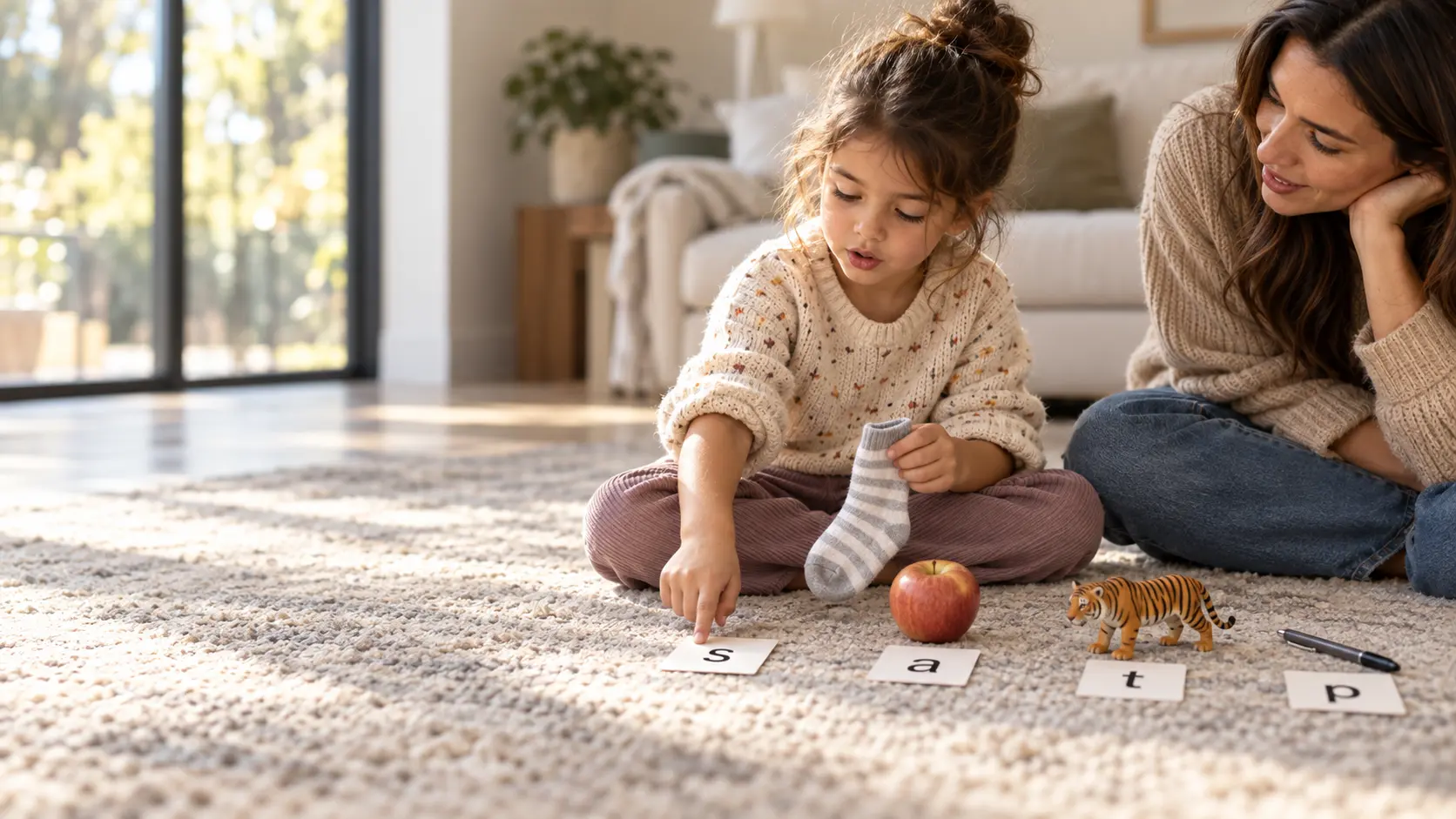
- Pick 3-5 target sounds for the week and keep game tasks tied only to that set.
- Run a short game loop: 2 minutes sound recall, 3-4 minutes game challenge, 2 minutes blend transfer on simple words.
- Use a pure-sound check while playing (for example /m/, not "muh") and correct gently in real time.
- Rotate game formats lightly (card flip, sound hunt, matching race) while keeping the same sound goal.
- Track one signal daily: response speed, sound accuracy, and ability to use those sounds in a blended word.
- If sound accuracy is unstable for a week, reduce target sounds and increase oral-only reps before adding new game complexity.
Checklist when choosing a phonics class
- The program is systematic: sounds -> blending -> decodable reading -> spelling.
- Children read decodable text based on taught sounds, not picture guessing.
- Parents get weekly progress updates with clear home-practice goals.
- Choose games or classes that require spoken sound output, include immediate correction, and verify transfer from sound game to blended word reading.
Mistakes that slow progress
- Do not switch methods every week; children need repeated routines to build automaticity.
- Do not rely only on worksheets; children need oral sound work and reading aloud.
- Do not over-correct every error; model once, retry, and praise effort quickly.
- Avoid reward-first games where children can score without producing sounds accurately. Avoid introducing too many new sounds in one session.
Progress timeline parents can expect
Typical pattern: better sound recall in 1-2 weeks, cleaner sound production in 2-4 weeks, and more reliable blending transfer in 4-6 weeks with consistent routines.
Useful examples parents can use tonight
Use these examples directly during practice so your child sees the concept in real words and short sentences.
- Use a 10-minute loop: 2 minutes sound review, 4 minutes blending, 4 minutes decodable reading.
- Keep a 3-old + 2-new word rule so review and new learning stay balanced.
- Use parent script: "Try it slowly, then fast." Avoid giving the answer immediately.
- End each session with one success sentence your child can read aloud independently.
Parent-guide scripts to keep practice positive
- Before practice: "We will do only 10 minutes, then stop."
- During practice: "Show me the sounds first, then blend."
- After effort: "I liked how you tried again when it felt tricky."
- For correction: "Let us check it together slowly, then you try once more."
When to ask for extra support
If your child can play games but still cannot apply sounds in blending after 6-8 weeks, move to structured teacher-led decoding support.
Related reading in this phonics cluster
- Online phonics games: /blog/online-phonics-games
- Phonics blending activities: /blog/phonics-blending-activities
- How kids learn blending: /blog/how-kids-learn-blending
- What is phonics for kids?: /blog/what-is-phonics-for-kids
Parent FAQ
Are digital phonics games enough by themselves?
Usually not. Children still need guided adult feedback and explicit transfer practice so game skills become reading skills.
How long should a phonics game session be?
About 5-8 focused minutes is usually enough before moving to blending, reading, or spelling transfer.
What is a sign a letter-sound game is high quality?
A strong sign is that your child must say sounds correctly, receives immediate correction, and then applies those sounds in real words.
Should I teach letter names and letter sounds together in games?
You can include both, but prioritize sound production for early reading. Letter names should not replace sound practice.
My child says sounds correctly in games but forgets during reading. Why?
Transfer is not yet automatic. Add a short post-game blending step every session so sounds move into word reading.
How many sounds should I teach at once?
Start small with 3-5 sounds and expand only when recall and pronunciation are stable with low prompting.
How often should parents do phonics at home?
Aim for 10 minutes a day, 5-6 days a week. Short daily practice gives better results than one long weekend session.
What should I do if my child refuses phonics practice?
Shrink the task to 2-3 minutes, switch to a game, and end with one success. Consistency with low pressure works better than forcing long sessions.
When should I seek extra support?
If your child has regular practice for 6-8 weeks but still cannot match basic sounds or blend simple CVC words, get an assessment from a phonics specialist.