Phonics

Phonics Blending Activities: Daily Drills That Fix Real Blending Gaps

Parent guide to phonics blending activities: clear answers, a 10-minute home routine, class-selection checkpoints, and realistic milestones to help your child become a confident reader.

Tiny Steps Academic Team16 Nov 20259 min

Parents often search

  • Why does my child know sounds but still not blend?
  • Should I correct blending instantly?
  • How many words should I use in one blending activity?
  • My child blends in drills but guesses in books. Why?

Best for

Decoding and blending support

Useful for parents working on sounds, CVC words, tricky words, and calmer reading routines.

Use this when

Reading feels stuck

A practical route for families who want progress without turning phonics into pressure.

Next best route

Phonics Mission

Pair this article with the 7-day home phonics plan if you want a stronger weekly routine.

Phonics Blending Activities: Daily Drills That Fix Real Blending Gaps

Article snapshot

Quick answer

Parent guide to phonics blending activities: clear answers, a 10-minute home routine, class-selection checkpoints, and realistic milestones to help your child become a confident reader.

Category

Phonics

Best next move

Use the Parents Hub playbooks for a calmer weekly routine, progress checkpoints, and low-pressure support.

Content ownership

Published by Tiny Steps Learning. This article is prepared by the Tiny Steps academic team to help parents make practical English-learning decisions.

Quick answer

Phonics Blending Activities: Daily Drills That Fix Real Blending Gaps

Parent guide to phonics blending activities: clear answers, a 10-minute home routine, class-selection checkpoints, and realistic milestones to help your child become a confident reader.

Quick answer for parents

Blending improves fastest when practice is structured and diagnostic: oral merge first, then printed word blending, then sentence transfer. The key is not more words, but the right drill for the exact blending error.

At-home plan: 10 minutes that actually works

If you are currently researching phonics blending activities, run this simple routine for 2-3 weeks before judging progress.

  • Run a fixed 8-10 minute blending block: 3 minutes oral blending, 4 minutes print blending, 1-2 minutes sentence transfer.
  • Use a small drill set per day (5-8 words) so your child can retry and stabilize accuracy before adding new patterns.
  • Match drill to error type: sound-dropping -> slower sound taps; vowel confusion -> contrast pairs; guessing -> no-picture decodable words.
  • Use one correction sequence: pause, model once, blend together once, then child retries independently.
  • Track two daily metrics: blending accuracy and number of independent retries before adult help.
  • If blending quality drops for 3-4 sessions, reduce word complexity for 2 days, then rebuild gradually.

Checklist when choosing a phonics class

  • The program is systematic: sounds -> blending -> decodable reading -> spelling.
  • Children read decodable text based on taught sounds, not picture guessing.
  • Parents get weekly progress updates with clear home-practice goals.
  • Pick classes that teach blending as a trainable process: slow-to-smooth blending, error-type correction, and weekly evidence on unfamiliar-word decoding.

Mistakes that slow progress

  • Do not switch methods every week; children need repeated routines to build automaticity.
  • Do not rely only on worksheets; children need oral sound work and reading aloud.
  • Do not over-correct every error; model once, retry, and praise effort quickly.
  • Avoid jumping to long words or passage reading before CVC and basic digraph blending are reliable. Avoid speed pressure before accuracy is stable.

Progress timeline parents can expect

Common trajectory: weeks 1-2 better oral merges; weeks 2-4 cleaner CVC blending; weeks 4-8 stronger transfer to short sentence reading with less guessing.

Useful examples parents can use tonight

Use these examples directly during practice so your child sees the concept in real words and short sentences.

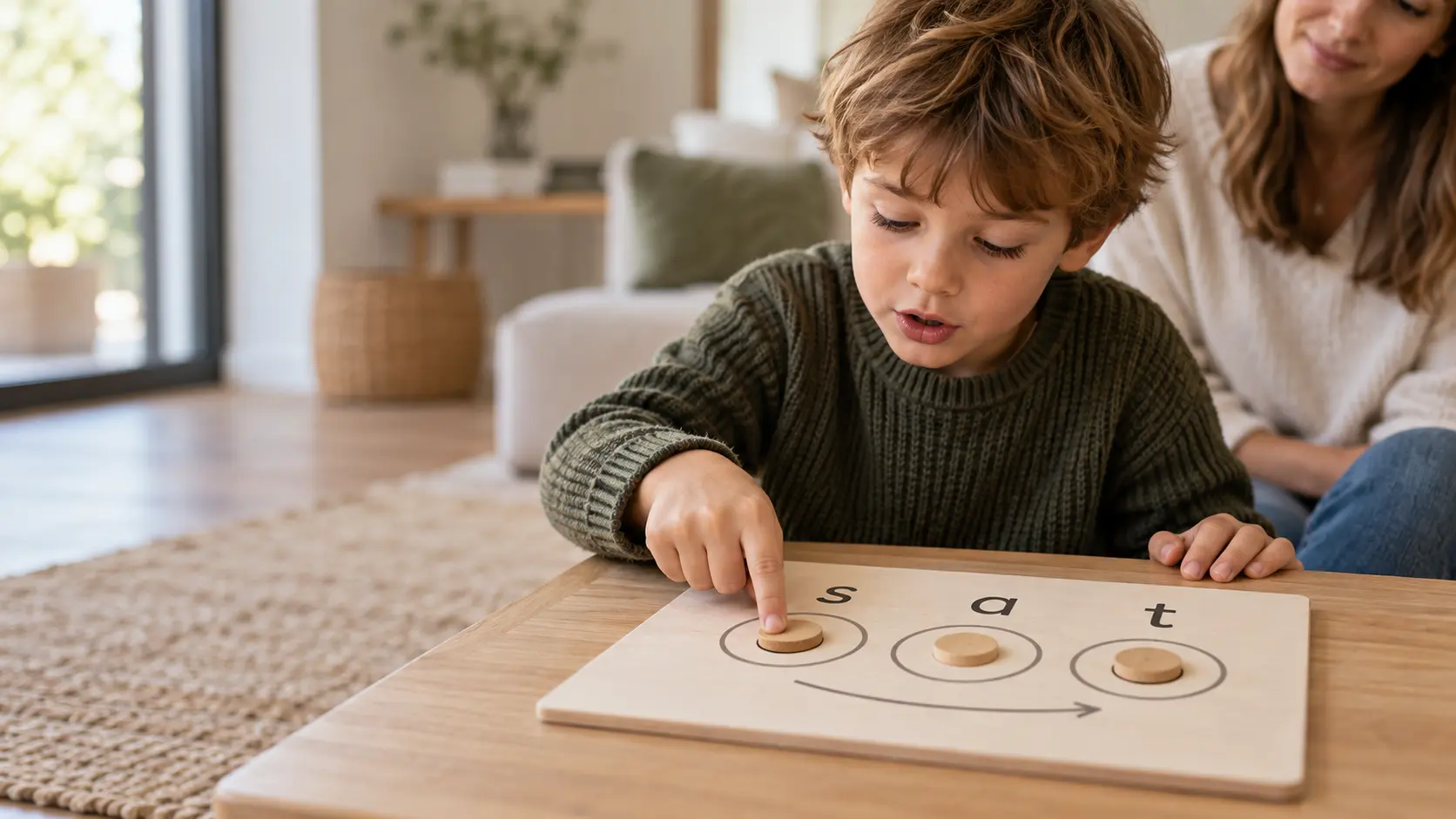
  • Oral-only blending set: /c/ /a/ /t/, /m/ /a/ /p/, /s/ /i/ /t/. No print first, just listening and joining.
  • Print blending set: cat, map, sit, pin, top. Parent slides finger under each grapheme while child blends.
  • Contrast drill: sat vs sit, pin vs pan, hop vs hip to strengthen vowel hearing.
  • Phrase practice: "a red cat", "sit up", "top hat" so blending moves into connected reading.
  • Correction script: "Let us sound slowly: /s/ /a/ /t/. Now fast: sat."
  • 3-step session: 3 oral blends + 3 printed words + 1 short decodable sentence.

Parent-guide scripts to keep practice positive

  • Before practice: "We will do only 10 minutes, then stop."
  • During practice: "Show me the sounds first, then blend."
  • After effort: "I liked how you tried again when it felt tricky."
  • For correction: "Let us check it together slowly, then you try once more."

When to ask for extra support

Seek structured support if your child can name sounds but still cannot blend basic words after 6-8 weeks of consistent, stage-matched blending drills.

Parent FAQ

Why does my child know sounds but still not blend?

Sound recall and blending are separate skills. Blending needs sequential sound holding plus merge practice, which must be taught explicitly.

Should I correct blending instantly?

Give a short pause first, then model once and prompt a retry. This builds self-correction rather than dependency.

How many words should I use in one blending activity?

Usually 5-8 words is enough per drill block. Too many words often reduces correction quality and carryover.

My child blends in drills but guesses in books. Why?

Transfer is not yet stable. Add short no-picture decodable lines immediately after drills so blending applies to connected text.

Should I blend letter names or letter sounds?

Blend letter sounds. Letter-name blending usually slows decoding and can create confusion for beginners.

When should I introduce longer words?

Introduce longer words only after basic CVC and common digraph blending are accurate with low prompting across several sessions.

How often should parents do phonics at home?

Aim for 10 minutes a day, 5-6 days a week. Short daily practice gives better results than one long weekend session.

What should I do if my child refuses phonics practice?

Shrink the task to 2-3 minutes, switch to a game, and end with one success. Consistency with low pressure works better than forcing long sessions.

When should I seek extra support?

If your child has regular practice for 6-8 weeks but still cannot match basic sounds or blend simple CVC words, get an assessment from a phonics specialist.

Parents also ask

Parents Also Ask

Common questions parents ask about this topic

Sound recall and blending are separate skills. Blending needs sequential sound holding plus merge practice, which must be taught explicitly.

Continue with Tiny Steps learning paths

Turn this article into a clearer next step

Continue with a structured phonics pathway, or review the full learning roadmap before choosing the next program.

About the AuthorFoundations ForeverParent-first teaching
Priya, Founder of Tiny Steps Learning, early childhood English educator
Priya, Tiny Steps Founder

Tiny Steps Founder

Priya

With 10+ years of experience in early childhood English education, Priya founded Tiny Steps Learning to help children ages 3-12 build phonics, grammar, writing, and speaking confidence through calm, research-informed teaching.

Why this section matters

Tiny Steps content is built for families who need clear next steps, strong foundations, and realistic home routines.

Ages served

3-12 years

Focus areas

Phonics, grammar, speaking

Approach

Learning science + low-pressure routines

Editorial note

Every Tiny Steps guide is designed to reduce parent guesswork and turn teaching advice into small actions children can repeat with confidence.

Recommended Next for Parents

Looking for more structured support?

Explore our main programs, related guides, or compare courses directly.