How Kids Learn Blending: The Stage-by-Stage Path Parents Can Track
See how kids learn blending from oral sounds to printed words and sentences, with stage-by-stage checks, common errors and clear next steps for parents.
Should children learn oral blending before printed blending?
Why does my child know letter sounds but cannot blend them into a word?
How do I know when my child is ready to move to harder blending?
Best for
Decoding and blending support
Useful for parents working on sounds, CVC words, tricky words, and calmer reading routines.
Use this when
Reading feels stuck
A practical route for families who want progress without turning phonics into pressure.
Next best route
Phonics Mission
Pair this article with the 7-day home phonics plan if you want a stronger weekly routine.
Guide index
Quick answerStart here
Quick answer: how do children learn to blend sounds into words?
Blending means combining phonemes—the smallest speech sounds—into a whole word. A child might hear /m/ /a/ /p/ and say “map”, then later look at m-a-p in print, retrieve the taught sounds and merge them into the same word. The important progression is not a fixed number of days or weeks. It is a move from oral blending, to print-based blending, to increasingly independent decoding of fresh words, and finally to using the same process successfully inside connected text.
Children do not need to know every letter before blending begins. They need a small set of securely taught sound-letter correspondences that can form useful words, plus enough phonemic awareness to hold and merge the sounds. If alphabet knowledge itself is the problem, start with Child Knows ABC but Cannot Read. If the child already recalls sounds but cannot join them into words, this blending pathway is the more useful page.
Guide section 02
Blending is a verb—not the same thing as a consonant blend
Parents often hear two different uses of the word “blend”. In reading instruction, to blend means to merge phonemes into a word. A so-called consonant blend such as st or bl contains separate phonemes that still need to be processed individually. By contrast, a digraph such as sh can represent one phoneme even though it uses two letters.
For example, “stop” contains /s/ /t/ /o/ /p/. The letters s and t are adjacent, but they are not one sound. “Shop” contains /sh/ /o/ /p/; sh is a digraph representing one phoneme. This distinction matters because a child learning to blend needs to account for the sound sequence accurately, not memorise letter clusters as visual chunks without understanding their sounds.
Guide section 03
The Tiny Steps five-stage blending path
This five-stage path is Tiny Steps editorial teaching guidance, not a standardized developmental test. Use it to locate the first point where a child loses the sound sequence or starts depending heavily on adult prompting.
Stage 1 — Oral blending: can the child merge sounds without print?
Begin with listening. Say a simple word one phoneme at a time, such as /m/ /a/ /p/, and ask the child to say the whole word. There are no letters to look at yet. This separates the sound-merging skill from letter recognition.
Use words whose spoken sounds are familiar to the child; the purpose is hearing and merging, not testing vocabulary.
If the child cannot merge two or three spoken phonemes, more printed word cards are unlikely to solve that exact bottleneck. Work orally first, then reconnect to print.
Stage 2 — Print connection: can the child retrieve taught sounds and blend a simple word?
Now show a short word made only from correspondences the child has already been taught. The task becomes two-part: retrieve the sound for each grapheme and merge those sounds into a recognizable word.
Use a small taught set rather than the whole alphabet. Early SATPIN-style combinations can be useful because a few correspondences quickly create multiple decodable words.
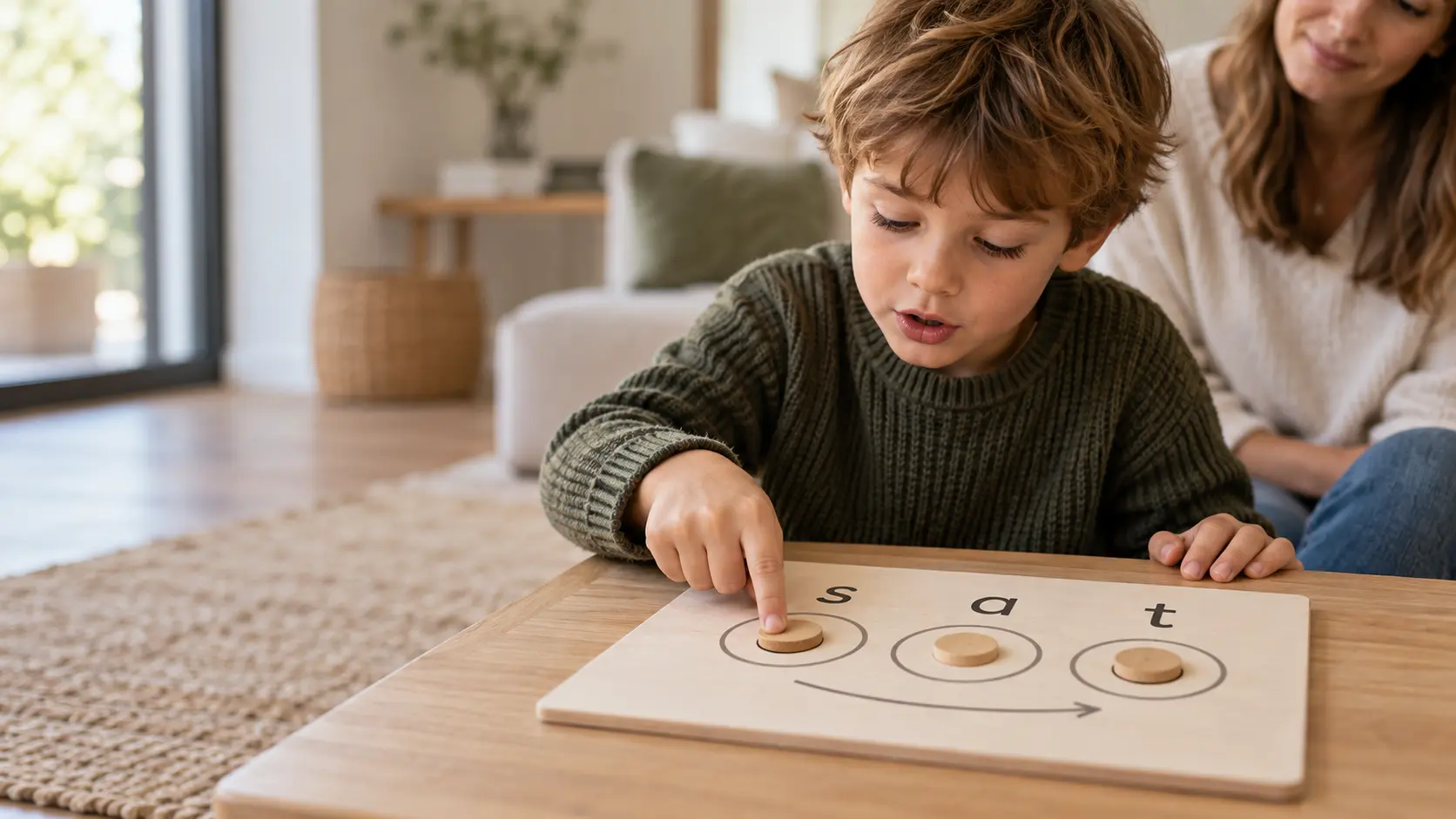
Point from left to right under the graphemes while the child says and merges the sounds. The print—not a picture—should supply the information needed to read the word.
If the child knows the sounds individually but pauses so long that the first sound is lost before the last one is reached, the issue is not necessarily sound knowledge; the blending process itself may still be effortful.
Stage 3 — Continuous blending: can the child keep the sound sequence connected?
Many beginners produce sounds as separate bursts—/m/ … /a/ … /p/—and then cannot recover the word. Continuous blending reduces that gap. Where a sound can be stretched naturally, hold it into the next sound rather than inserting pauses or an extra “uh”: /mmmaaap/ → map.
Not every phoneme can be stretched. Stop sounds such as /t/, /p/ and /k/ should be kept brief and clean. The goal is not theatrical stretching; it is to avoid adding schwa sounds such as “tuh” or “puh”, because those extra vowels make the final word harder to hear.
Parent prompt: “Keep the sounds touching. Start here and slide through the word.”
If continuous blending helps, gradually reduce the adult model so the child takes over the left-to-right merge.
Stage 4 — Fresh-word transfer: can the child blend an unfamiliar decodable word?
A familiar practice list can hide memorisation. The stronger signal is a fresh word containing only taught correspondences. If the child can blend it without being told the word first, the process is becoming transferable.
Change the order of known words so the child cannot rely on list position.
Include one or two fresh regular words from the taught pattern set.
Once simple CVC blending is stable, add already-taught digraphs or adjacent consonants systematically rather than jumping to random harder words.
Stage 5 — Connected-text transfer: can the child keep blending inside a sentence?
Single-word success is not the endpoint. The child needs to use the same decoding process while reading a short sentence or decodable text matched to the taught phonics scope. At first, some words may still require deliberate sounding and blending. With successful repeated encounters, familiar words can become increasingly automatic.
Use short text with a high proportion of already-taught correspondences so the child has a fair chance to decode.
If sentence reading causes a sudden rise in guessing, reduce text complexity before assuming the child has “forgotten phonics”.
After decoding a difficult word, reread the full sentence so attention returns to phrasing and meaning.
Guide section 04
How to decide when a child is ready to move to the next blending stage
Do not use a fixed calendar such as “five days at Stage 1” or “two days of revision”. Move when the skill is showing up repeatedly with less help and across fresh examples.
Accuracy — the child preserves the sound sequence and arrives at the intended word.
Independence — adult modelling and prompts are reducing.
Transfer — the child can blend a fresh word built from taught correspondences.
Retention — the same skill is still available after a break or in the next practice session.
Text use — the strategy begins to hold when the word appears inside a short matched sentence.
These are observation signals, not pass/fail cut-offs. A child can be stronger on one signal than another, and the right response is usually to strengthen the weak component rather than restart the entire programme.
Guide section 05
Common blending errors and what they usually tell you
The child says each sound correctly but cannot make the word
Sound recall may be adequate while phoneme merging is still weak or effortful. Return briefly to oral blending and continuous blending rather than teaching more graphemes.
The child adds “uh” to consonants
A pronunciation such as /muh/ /a/ /puh/ inserts sounds that are not in “map”. Model clean, blendable phonemes and keep stop sounds brief.
The child guesses from the first letter
Bring attention back to the full printed sequence. Ask the child to account for each taught grapheme and blend through the whole word before checking meaning.
The child blends familiar cards but not new words
That suggests list familiarity may be carrying part of the performance. Mix the order and use a few fresh regular words from the same taught scope.
The child can blend words but breaks down in sentences
The word-reading process may still consume a lot of attention. Use shorter, better-matched decodable text and reread after successful decoding instead of increasing word difficulty immediately.
Guide section 06
A simple parent practice structure without a fixed daily dosage
This article does not prescribe a research-defined number of minutes or days per week. Keep practice short enough to preserve accurate effort and choose tasks from the child’s current blending stage.
Oral warm-up — merge a few spoken sound sequences if oral blending still needs support.
Printed blending — read a small set made only from taught correspondences.
Fresh transfer — include at least one unfamiliar regular word from the same scope.
Connected text — finish with one short decodable line when the child is ready for sentence transfer.
Do not ask the child to guess from pictures or sentence context instead of processing the print.
Do not keep adding new graphemes when the current taught set cannot yet be blended reliably.
Do not turn blending into a speed race before accuracy and sound sequence are secure.
Do not judge mastery only from a memorised word family or repeated flashcard list.
Do not make the child repeat isolated sounds endlessly when the real bottleneck is merging them into words.
Guide section 08
When to ask for a closer review
Ask the child’s teacher or a qualified reading professional for a closer look when the child remains persistently unable to merge spoken or printed sounds despite explicit, appropriately levelled teaching, or when speech, language, hearing, memory, attention or broader learning concerns may also be affecting progress. The useful question is which component is breaking—phonemic awareness, sound-letter retrieval, sequencing, blending, or transfer—not simply whether the child is “bad at reading”.
This article is educational guidance and cannot diagnose dyslexia, developmental language disorder, hearing difficulty or any other condition. For a broader home observation across taught phonics skills, use the Phonics Assessment Checklist.
Evidence behind this guide
Evidence behind the blending pathway
The Tiny Steps five-stage pathway and stage-exit signals above are editorial teaching guidance rather than a standardized research protocol. The evidence below supports the underlying principles: phonemic awareness includes blending spoken sounds; children need to link phonemes with graphemes; decoding should be taught systematically from left to right; practice should progress through words into connected text; and clean, blendable sound pronunciation helps children combine sounds successfully.
IES / What Works Clearinghouse — Foundational Skills to Support Reading for Understanding in Kindergarten Through 3rd Grade
recommends developing awareness of speech sounds and their links to letters, explicitly teaching children to blend letter sounds and spelling patterns from left to right, and providing connected-text practice.
University of Florida Literacy Institute — Phoneme-Grapheme Correspondences
explains that sound pronunciations should be modelled in a way that supports blending and that correspondence teaching should follow a systematic scope and sequence.
UK Department for Education — The Reading Framework
sets out evidence-informed guidance for systematic synthetic phonics, including teaching children to blend phonemes to read words and apply phonics in decodable texts.
Continue with the learning path that matches this need
If this is the same need you see in your child, the relevant programme is the most useful next step. For supporting context, review the Foundation Phonics stage.
Parents also ask
Parents Also Ask
Common questions parents ask about this topic
Blending is combining phonemes in sequence to make a whole word. A child might hear or read /c/ /a/ /t/ and merge the sounds to say “cat”. It is the bridge from knowing individual sounds to decoding words.
Oral blending can help isolate the sound-merging skill because no letter recognition is required. In systematic phonics, it should then connect quickly to print so the child learns to use taught grapheme-phoneme correspondences for real word reading.
Knowing individual correspondences and merging a sound sequence are related but different demands. The child may lose the first sound, insert pauses or schwa sounds, or still need explicit oral and continuous-blending practice before the process becomes independent.
Look for repeated accuracy, less adult prompting, successful fresh-word decoding and transfer into short matched text. Do not use a universal word count or fixed number of practice days as the stage-exit rule.
Not by itself. Early blending can be effortful. Accuracy and preservation of the sound sequence matter before speed. Smoothness usually develops as taught correspondences and word-reading routines become more automatic through successful practice.
Priya leads Tiny Steps Learning's academic direction across phonics, reading, grammar, writing, and communication, including curriculum design, teacher guidance, and teaching quality.
Updated 30 Aug 2026
Sources: 4 external source links cited in this article
Turn phonics practice into a structured learning path
If you are unsure whether your child needs more sound work, blending practice or the next decoding stage, a free 35-minute 1:1 assessment can help you choose the right starting point.