Phonics

Online Phonics Games: What Helps, What Wastes Time, and What to Do Next

Parent guide to online phonics games with skill-by-skill game types, age guidance (3-4, 5-6, 7+), distraction filters, and a stage-matching plan that connects games to real reading progress.

Tiny Steps Academic Team12 Dec 20259 min

Parents often search

  • How much screen time is enough for online phonics games?
  • Do children still need a live teacher or parent when using phonics games?
  • When are online phonics games not enough on their own?
  • How do I know a phonics game is actually teaching, not just entertaining?

Best for

Decoding and blending support

Useful for parents working on sounds, CVC words, tricky words, and calmer reading routines.

Use this when

Reading feels stuck

A practical route for families who want progress without turning phonics into pressure.

Next best route

Phonics Mission

Pair this article with the 7-day home phonics plan if you want a stronger weekly routine.

Online Phonics Games: What Helps, What Wastes Time, and What to Do Next

Article snapshot

Quick answer

Parent guide to online phonics games with skill-by-skill game types, age guidance (3-4, 5-6, 7+), distraction filters, and a stage-matching plan that connects games to real reading progress.

Category

Phonics

Best next move

Use the Parents Hub playbooks for a calmer weekly routine, progress checkpoints, and low-pressure support.

Content ownership

Published by Tiny Steps Learning. This article is prepared by the Tiny Steps academic team to help parents make practical English-learning decisions.

Quick answer

Online Phonics Games: What Helps, What Wastes Time, and What to Do Next

Parent guide to online phonics games with skill-by-skill game types, age guidance (3-4, 5-6, 7+), distraction filters, and a stage-matching plan that connects games to real reading progress.

Quick answer for parents

Online phonics games are useful as reinforcement, not as the full reading plan. They work when parents pick games by exact skill gap, keep sessions short, and force transfer to print reading immediately after play.

Game types by skill: what each type should train

  • Letter sounds games: children hear a sound and map it to the correct letter or letter team. Good for early sound recall, not full reading yet.
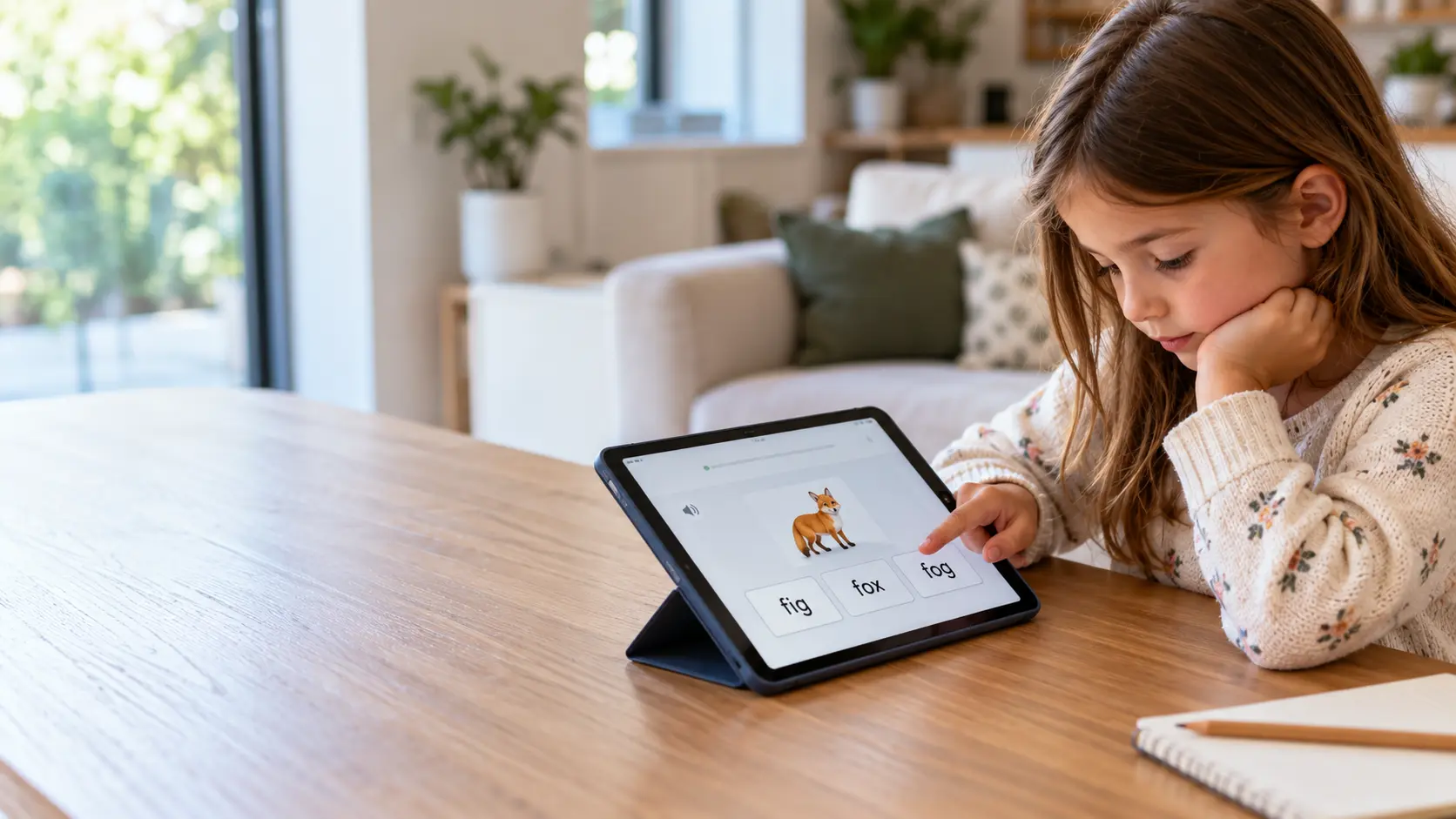
  • Blending games: children join 2-4 sounds into a word (for example, /c/ /a/ /t/ -> cat). This is the core bridge from sounds to decoding.
  • Segmenting games: children break spoken words into sounds before spelling. Useful when reading is ahead of spelling accuracy.
  • Tricky-word games: children rehearse high-frequency words that are not fully decodable at current level. Keep list size small and reviewed.
  • Fluency games: repeated phrase or sentence reading with accuracy before speed. Best after basic decoding is already stable.

Which games work by age group

Ages 3-4

  • Best fit: short letter-sound matching, oral sound-play, and listening-response games with adult support.
  • Session length: 5-8 minutes max before switching to movement or print-light activities.

Ages 5-6

  • Best fit: blending and segmenting games on simple CVC words plus small tricky-word sets.
  • Session length: 8-12 minutes, then immediate transfer to reading 3-5 words or 1 short sentence.

Ages 7+

  • Best fit: complex blending, spelling pattern games, and fluency drills tied to connected text.
  • Session length: 12-15 minutes with focus on accuracy, self-correction, and meaning checks.

Signs a phonics game is helpful vs distracting

Helpful signs

  • The game targets one clear reading skill per round, not mixed random tasks.
  • Errors trigger immediate correction and retry, not only points or animations.
  • Your child can apply the same pattern in print right after the game.
  • Progress is visible in fewer guesses and steadier blending over 2-3 weeks.

Distracting signs

  • Children can win by tapping fast without reading the full word.
  • Too many visual rewards interrupt focus more than they support decoding.
  • No clear level pathway from sounds to words to sentence reading.
  • Performance improves in-app but not in book reading or school tasks.

How to match a game to your child’s current reading stage

  • Stage 1 (sound awareness): choose letter-sound listening games. Move up when your child can recall taught sounds without prompts.
  • Stage 2 (early decoding): choose blending games on short words. Move up when blending is accurate and less effortful.
  • Stage 3 (spelling transfer): choose segmenting + spelling games. Move up when word spellings stabilize across practice days.
  • Stage 4 (connected reading): choose fluency games tied to short passages. Stay here until expression and comprehension improve together.

How this differs from adjacent Tiny Steps phonics pages

  • This page is a decision guide for choosing online games by skill and stage, not just a list of activities.
  • For letter-sound-only ideas, use the separate phonics games for letter sounds article.
  • For offline routines and printable home practice, use the phonics activities for kids at home article.
  • For the full live program pathway (assessment, teaching, progress), use the main phonics program page.

When games are not enough on their own

If your child still guesses heavily, cannot blend basic words, or avoids print after 6-8 weeks of guided game-plus-transfer practice, switch to structured live instruction.

  • Use games as reinforcement, not replacement, for explicit phonics teaching.
  • Escalate to guided instruction when guessing patterns persist across weeks.
  • Review stage placement regularly so game difficulty matches current reading level.

Parent FAQ

How much screen time is enough for online phonics games?

For most children, 8-12 focused minutes is enough when followed immediately by 3-5 minutes of offline blending, reading, or spelling.

Do children still need a live teacher or parent when using phonics games?

Yes. Games help with repetition, but children still need guided correction and stage-appropriate next steps from a teacher or parent.

When are online phonics games not enough on their own?

If your child keeps guessing words, cannot blend reliably, or reads with repeated breakdowns after 6-8 weeks, structured live teaching is usually needed.

How do I know a phonics game is actually teaching, not just entertaining?

Check whether your child can apply the target skill on new words outside the game. If transfer is absent, the game is likely entertainment-heavy.

Should I use different games every day to avoid boredom?

No. Keep the skill target stable and rotate lightly. Frequent full switches often reduce retention and make progress hard to measure.

Can games help children who resist worksheets?

Yes, as an entry point. But add a short print or oral transfer step after play so game success becomes reading success.

Parents also ask

Parents Also Ask

Common questions parents ask about this topic

For most children, 8-12 focused minutes is enough when followed immediately by 3-5 minutes of offline blending, reading, or spelling.

Continue with Tiny Steps learning paths

Turn this article into a clearer next step

Continue with a structured phonics pathway, or review the full learning roadmap before choosing the next program.

About the AuthorFoundations ForeverParent-first teaching
Priya, Founder of Tiny Steps Learning, early childhood English educator
Priya, Tiny Steps Founder

Tiny Steps Founder

Priya

With 10+ years of experience in early childhood English education, Priya founded Tiny Steps Learning to help children ages 3-12 build phonics, grammar, writing, and speaking confidence through calm, research-informed teaching.

Why this section matters

Tiny Steps content is built for families who need clear next steps, strong foundations, and realistic home routines.

Ages served

3-12 years

Focus areas

Phonics, grammar, speaking

Approach

Learning science + low-pressure routines

Editorial note

Every Tiny Steps guide is designed to reduce parent guesswork and turn teaching advice into small actions children can repeat with confidence.

Recommended Next for Parents

Looking for more structured support?

Explore our main programs, related guides, or compare courses directly.