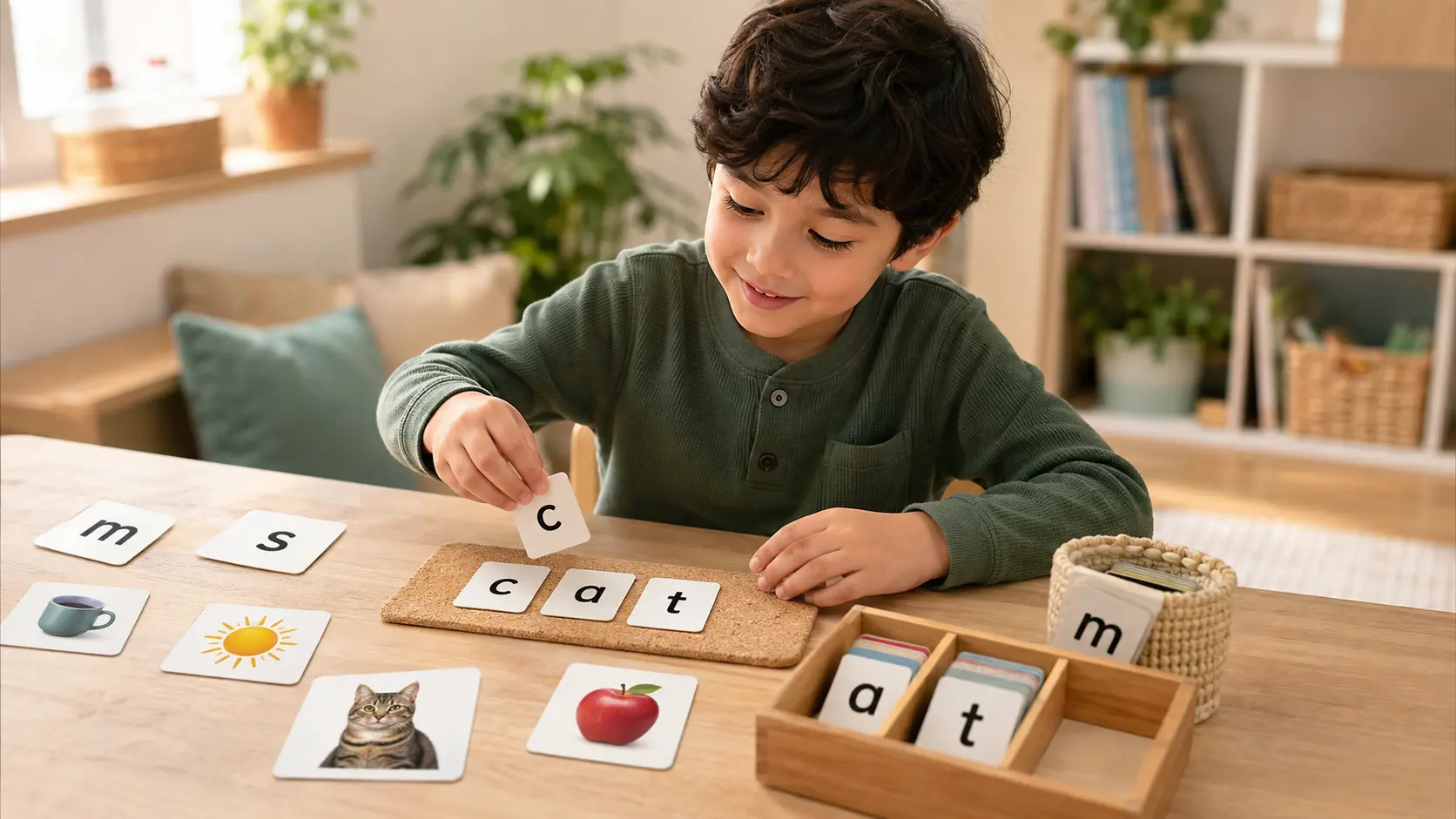
Quick answer: how should parents practise r-controlled vowels?
Practise **one already-taught r-controlled pattern or comparison at a time**, make the child attend to the complete spelling, then connect the same pattern across reading, spelling and a fresh word or short sentence. A game, gesture or sorting activity is useful only if the child still has to retrieve and apply the sound-spelling relationship.
For **ar** and **or**, start with clear examples from the child’s programme. For **er, ir and ur**, remember that these spellings can represent very similar sounds in many accents. Reading the words and choosing the conventional spelling are therefore related but different challenges. Do not treat a spelling choice such as er versus ir as something the child should be able to hear perfectly in every word.
This article owns practice — This guide covers the pattern explanation and sequence
If you need the broader explanation of what r-controlled vowels are, how the pattern groups relate, common confusions and a sensible teaching order, use R-Controlled Vowels Explained. This article has a narrower job: **practical activities for practising r-controlled spellings that the child has already been taught**.
That boundary matters. A home activity should reinforce the child’s current phonics programme rather than introduce all five spellings because they happen to appear in one worksheet.
A note about pronunciation and accent before you begin
R-controlled vowel pronunciation varies across English accents. In rhotic accents, the **r** is usually pronounced in words such as car or bird; in many non-rhotic accents, the vowel quality changes while the final or following r may not be pronounced in the same way. The practical rule for parents is simple: **use the pronunciation model from the child’s school or phonics programme and do not mark a normal accent difference as a reading error**.
The spelling still matters even when pronunciations differ. The child needs to notice the printed pattern, decode the word according to the pronunciation model they use, and learn the conventional spelling where several graphemes can represent a similar sound.
Before choosing an activity, choose the target
- **If ar is new**, keep practice mainly with ar until the child can notice and use it with decreasing prompting.
- **If or is new**, practise or separately before creating a large ar/or mixed sort.
- **If er, ir and ur are all already taught**, compare their spellings carefully because the vowel sound may be similar even when the grapheme differs.
- **If the child is still insecure with short-vowel CVC decoding**, strengthen that foundation rather than using r-controlled words to solve an earlier blending problem.
The target should come from what the child has actually been taught, not from age, a week number or a generic internet list.
The Tiny Steps six-part r-controlled practice loop
Use this as flexible editorial teaching guidance rather than a standardized assessment or fixed practice dose.
- **Choose** — select one taught pattern or one purposeful comparison.
- **Hear** — say a few words naturally so the child notices the target sound in speech.
- **Notice** — find and name the grapheme in the printed word.
- **Decode** — read the whole word rather than identifying only the vowel+r chunk.
- **Encode** — spell a suitable word from the spoken form, using the taught grapheme knowledge.
- **Transfer** — apply the same pattern in a fresh word or matched sentence.
A child who can point to **ar** on a card has shown recognition of the pattern. A child who can use **ar** to decode an unfamiliar suitable word and then spell another taught example has shown stronger transfer.
Activity 1 — Hear, find and read the target pattern
Choose one taught family, such as **ar**. Say several words naturally, including a few with and without the target sound. The child identifies the words containing the sound, then moves to printed cards and finds **ar** inside each target word before reading the complete word.
For example, use **car, farm, park, dark** alongside appropriate non-ar contrasts from the child’s current knowledge. The listening step helps focus attention, but the activity is not complete until the child returns to print and decodes.
Activity 2 — Pattern sort with a reading requirement
Once two groups have been taught, mix words from those groups. A simple early comparison might be **ar** versus **or**. The child must **read the whole word first**, then place it in the correct column.
- **ar:** car, farm, park, dark, start
- **or:** fork, corn, storm, short, born
Do not award success for visually spotting the letters and sorting without reading. Sorting is useful because it organises the spelling patterns; decoding is what turns it into reading practice.
Activity 3 — Build and change the word
Use magnetic letters, cards or handwritten tiles. Build one word, read it, then change one part while keeping the r-controlled pattern visible. Examples include **car → cart**, **farm → harm**, **fork → fort** or other words that match the child’s taught code and vocabulary.
After every change, ask the child to read from left to right. The point is not rapid word-chain performance; it is noticing which letters changed and which sound-spelling relationship stayed stable.
Activity 4 — Read, cover, spell, check
Show a suitable word containing the current pattern. The child reads it and identifies the r-controlled spelling. Cover the word, say it naturally, and ask the child to segment and spell it. Reveal the word and compare.
This is especially informative for **er, ir and ur**. A child may read **bird** correctly because **ir** is visible but spell the same sound with another plausible r-controlled grapheme. That tells you the reading correspondence is more secure than the conventional spelling choice; it does not automatically mean the child failed to hear the sounds.
How Phonics Improves Spelling, owns the full encoding progression. Here, spelling is a short check that strengthens the current r-controlled pattern.
Activity 5 — er, ir and ur spelling sort after the patterns are taught
In many accents, **er, ir and ur** can sound the same or very similar in words such as **her, bird, turn**. Once the child has been taught all three spellings, create three columns and sort familiar words by grapheme.
- **er:** her, term, fern
- **ir:** bird, shirt, first
- **ur:** turn, hurt, curl
Say each word, read it, identify the spelling and then place it. Do not tell the child they should always be able to decide er, ir or ur from the sound alone. English spelling often requires remembering which grapheme belongs in a particular word.
Activity 6 — Fresh-word transfer check
After a few rehearsed examples, give one unfamiliar but appropriately decodable word containing the same taught pattern. Keep the surrounding consonants within the child’s knowledge so the transfer check does not accidentally test several new skills at once.
If the child can read rehearsed **car, farm, park** but guesses on a fresh ar word, return to the pattern and reduce prompting. **Memorised-list success is practice evidence; fresh-word decoding is stronger transfer evidence.**
Activity 7 — Sentence transfer after accurate word reading
Put a taught r-controlled word into a short sentence or appropriately matched text. Let the child solve the target word from print first, then reread the complete sentence for phrasing and meaning.
A sentence such as **“The bird can turn.”** may be suitable only if the rest of the spellings are accessible to the child. Do not call a sentence “decodable” simply because it contains the target r-controlled word; the complete line has to match the child’s wider phonics knowledge.
Are gestures and “bossy R” stories useful?
They can be useful **memory cues**, provided they do not replace attention to print. A steering-wheel action for ar or a classroom phrase such as “bossy R” may help a child remember the target, but neither demonstrates decoding.
Use a cue briefly, then fade it. The stronger check is whether the child can notice the letters, read a fresh word and use the pattern without needing the gesture, picture or adult prompt.
Common problems and what to change
The child reads the vowel as if r were not there
Point to the complete vowel+r spelling, model the sound according to the child’s programme, then return the whole word for another attempt. Avoid simply supplying the answer.
The child confuses ar and or
Reduce the active set and compare one pair at a time. Let the child hear, notice, decode and spell examples before returning to a larger mixed sort.
The child reads er, ir and ur but cannot spell them reliably
Treat this as a spelling-choice problem when decoding is otherwise accurate. Build word-specific memory through reading, spelling and meaningful grouping instead of insisting that the child “listen harder” for a distinction that may not exist clearly in their accent.
The child identifies the pattern but guesses the word
Return attention to every grapheme in the word. Knowing that a card contains **ar** is not the same as blending the complete printed word.
The child reads the isolated word but loses it in a sentence
Reduce text difficulty and practise the target inside a shorter matched phrase or sentence. Connected-text transfer should add context, not overwhelm the decoding skill you are trying to observe.
Which words should parents avoid in early r-controlled practice?
Avoid examples that introduce another unusual spelling, advanced syllable pattern or pronunciation exception before the target family is secure. For example, words such as **word, work, world** should not be used as straightforward early examples of ordinary **or**, because their pronunciation does not match a simple or pattern in many accents.
Use examples from the child’s actual programme whenever possible. A familiar, well-controlled set is more useful than an impressive list of every word containing vowel + r.
How much practice is enough?
There is no universal research-defined number of r-controlled words, minutes, days, review intervals or percentage score that proves mastery. Use enough practice for attentive attempts and at least one meaningful transfer check, then stop before accuracy and attention deteriorate.
A useful session might contain only a few carefully chosen words. Another child may need more repetition. The decision should come from **accuracy, independence, retention and transfer**, not from completing a timer or card quota.
The Tiny Steps five-signal progress check
- **Recognition** — Does the child notice the taught vowel+r spelling inside the word?
- **Decoding** — Can the child read suitable words accurately without guessing from the first letter or picture?
- **Encoding** — Can the child spell taught examples with increasing control, while recognising that er/ir/ur may require word-specific spelling memory?
- **Retention** — Does the pattern remain available after a gap rather than only immediately after rehearsal?
- **Transfer** — Can the child use the pattern in a fresh word and matched text?
These are Tiny Steps observational signals, not standardized cut-offs or diagnostic criteria. Use them to decide whether to review, simplify or add another taught comparison.
When should parents ask for more support?
Ask the child’s teacher or an appropriate reading professional for more support if difficulty remains broad and persistent: basic sound-spelling recall is weak, blending breaks down across many word types, the child repeatedly guesses instead of attending through words, or previously taught patterns do not transfer despite appropriate instruction and review.
This article is educational guidance for practice, not a diagnostic assessment. Trouble with r-controlled vowels alone does not establish dyslexia, hearing difficulty, a speech-language condition or another learning diagnosis.
Evidence and references
The evidence base supports explicit, systematic sound-spelling instruction; decoding and analysing words; spelling/word writing; cumulative review; and applying taught knowledge in connected text. It does **not** establish one universal r-controlled activity sequence, gesture system, daily duration or mastery percentage. The Tiny Steps practice loop and five-signal check are editorial syntheses built around those broader principles.
- Institute of Education Sciences / What Works Clearinghouse — Foundational Skills to Support Reading for Understanding: evidence-rated guidance on sound-letter relationships, decoding, word analysis, spelling and connected-text reading.
- IES — Supporting Your Child’s Reading at Home: family resources for practising foundational sound-spelling and word-reading skills at home.
- University of Florida Literacy Institute — UFLI Foundations: explicit, cumulative phonics instruction and practice resources connecting decoding and encoding.
- Education Endowment Foundation — Phonics: evidence summary supporting systematic phonics and instruction matched to pupils’ current knowledge.
- UK Department for Education — The Reading Framework: guidance on systematic phonics, cumulative progression, accurate decoding, spelling and matched reading practice.
Useful next steps
- Read R-Controlled Vowels Explained for pattern groups, sequence decisions and common confusions.
- Use Long Vowel Practice for Kids if the current difficulty is with VCe, vowel teams or other long-vowel spellings rather than vowel+r patterns.
- Read How Phonics Improves Spelling if spelling is the main bottleneck.
- Explore Tiny Steps Phonics for structured live teaching and individual progression.
- Book a free trial assessment if you want help identifying the next phonics teaching target.
FAQs
Parent guide: how to use this weekly plan in real life
Use this weekly post as a practical checklist, not a one-time read. Keep routines short, repeat the same target for 5-7 days, and track one visible win.
- Choose one daily slot and keep it fixed (same time, same place).
- Do 10-15 focused minutes only; stop while your child still feels successful.
- Use one correction script: "Let us try slowly, then fast."
- Send one weekly note to the teacher: what improved, what still needs support.
Research basis: why this weekly plan works
This weekly structure reflects evidence-aligned classroom practice used in early literacy and communication instruction: explicit teaching, short retrieval cycles, and repeated guided practice with feedback.
- Distributed practice beats cramming: short sessions across the week improve retention better than one long session.
- Retrieval and correction loops build fluency: recall first, then immediate gentle correction, then one successful retry.
- Clear success criteria improve motivation: children engage better when the goal is visible and achievable in one session.
Tiny Steps quality standard for this week
Every Tiny Steps weekly blog should give parents a usable routine, measurable progress signal, and practical fallback when the child gets stuck. Use this page as a field guide, not theory-only reading.
- One concrete routine parents can run in 10-15 minutes.
- One measurable checkpoint (accuracy, fluency, or confidence) by week-end.
- One rescue strategy for low-motivation days so consistency does not break.
Real-world action plan: bossy-r practice that sticks
R-controlled vowels are easier when grouped by sound families and revisited through sentence reading and dictation.
10-minute at-home routine (realistic for busy parents)
- Day 1-2: AR family (car, star, farm, park) with a 2-minute picture sort.
- Day 3-4: OR family (fork, corn, storm, short) in quick read-and-point games.
- Day 5-7: ER/IR/UR mixed set (her, bird, turn, fur) plus one dictation sentence daily.
If your child gets stuck
If your child collapses all r-vowels into one sound, split practice by family and avoid mixed lists for two days.
End-of-week success signs
- Child correctly sorts words into AR, OR, and ER/IR/UR groups.
- Child reads one sentence per r-controlled family.
- Child spells at least four r-controlled words correctly in dictation.
Parents also ask this week
- Should I teach er/ir/ur separately first? Yes, but combine later because they sound similar.
- My child reads car as cah. Model slowly: /c/ /ar/ and repeat in short phrases.
Where this fits in the learning pathway
Use this route only if it matches the need you identified above: review the Advanced Phonics stage.