IES / What Works Clearinghouse — Foundational Skills to Support Reading for Understanding in Kindergarten Through 3rd Grade
recommends explicit work with sound–letter relationships, decoding, word writing and connected text.
Read sourceUse a simple home blending routine with taught sounds, continuous blending, fresh-word transfer, parent prompts, progress checks and clear support boundaries.
Parents often search
Prepare
Secure the sounds first
Check the required correspondences before treating a recall problem as a blending problem.
Blend
See → sound → sweep → say
Keep attention moving through the printed word with as little pause between sounds as the child needs.
Transfer
Fresh words + matched text
Use new regular words and short connected reading to check that blending is becoming usable beyond practice.
Keep the routine small and repeatable. Choose words that use sound–spelling correspondences your child has already been taught, help the child look across the whole printed word, blend the sounds from left to right, say the finished word naturally, and then check the same skill on a fresh word or short matched sentence. The useful evidence is less guessing, more independent blending and transfer — not how many cards the child finishes before a timer ends.
A daily routine can be brief, but there is no research-proven number of minutes, words or consecutive days that guarantees blending mastery. Some children need only a short reminder; others need slower teaching, fewer examples or more guided practice. This article owns the repeatable home routine. For a larger menu of activity types, use Phonics Blending Activities. For the developmental progression from oral blending into increasingly complex word reading, use How Kids Learn Blending.
Guide section 02
Knowing the alphabet is not the same as having usable decoding knowledge. If your child can name letters but cannot yet use their sounds to read words, Child Knows ABC but Cannot Read explains that gap. If you are beginning with the SATPIN sound set, SATPIN at Home gives the launch sequence.
Guide section 03
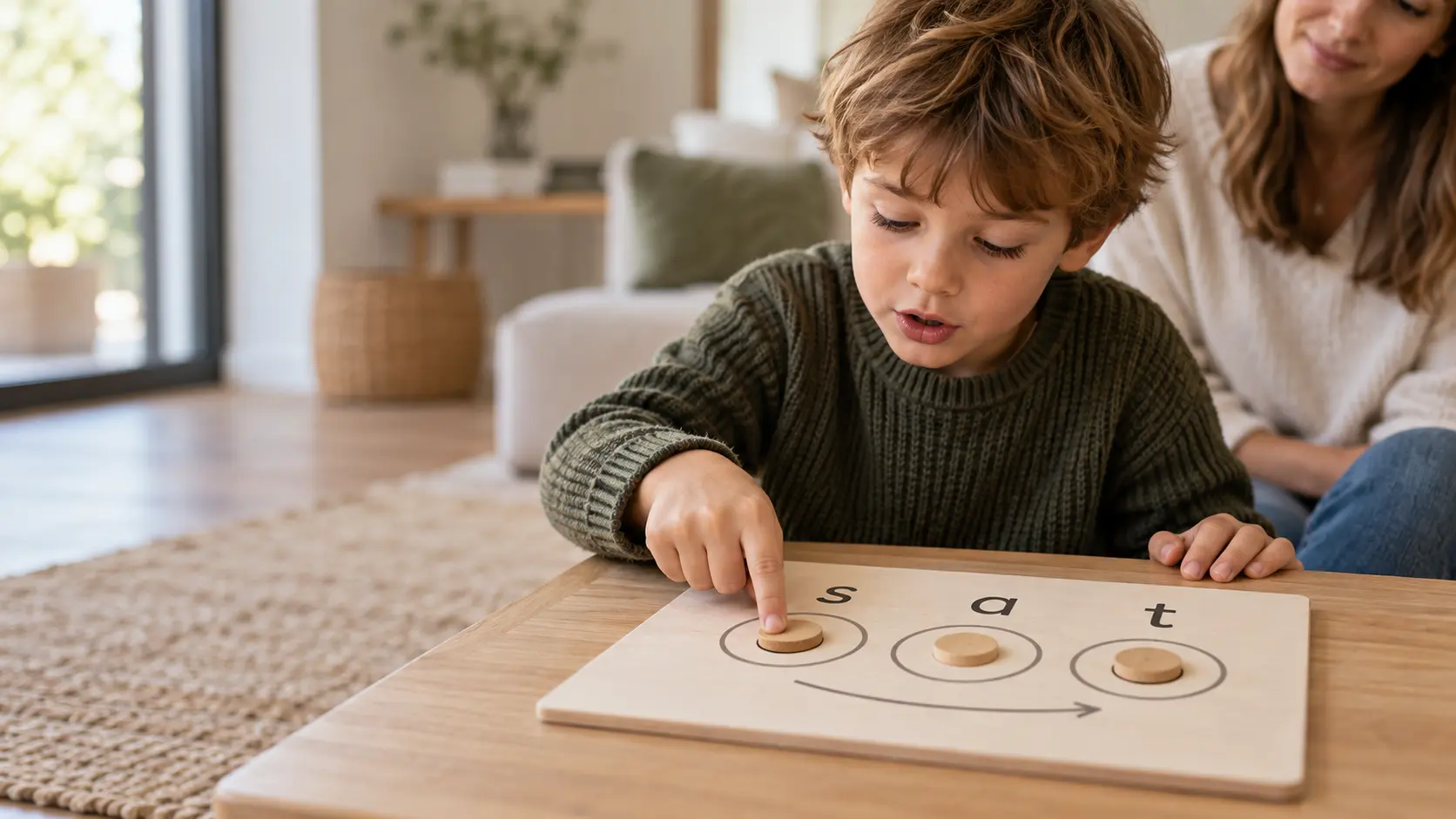
Blending is the process of combining the sounds represented by the graphemes in a printed word to produce the spoken word. For sat, the child attends to s–a–t, retrieves the taught sounds and combines them into “sat”. It is one part of decoding; it does not replace vocabulary, comprehension, spelling or wider reading.
Blending is also not guessing from the first letter, picture or sentence context. Meaning can help a reader check whether a decoded word makes sense, but it should not substitute for looking through the print when the child is practising a decodable word.
Guide section 04
Choose practice words whose important correspondences are already known. If the child has to learn a new digraph, remember a new vowel pattern and learn to blend all in the same attempt, you cannot tell which part caused the breakdown. Keep the word set inside the child’s taught code so the blending process is visible.
Use clean, blendable pronunciations where possible. Adding a strong extra vowel to consonants — for example turning /m/ into “muh” — can make the sounds harder to join because the child is trying to blend sounds that are not actually in the target word. Model the phoneme cleanly, then return attention to the whole printed word.
Guide section 05
At Tiny Steps, a useful home routine can be remembered as See → Sound → Sweep → Say → Transfer. This is an editorial teaching framework, not a standardized assessment or research-validated five-step protocol.
Put one appropriately decodable word in front of the child. Ask them to look from the first grapheme through to the end. This reduces the habit of seeing the first letter and jumping to a guess.
Let the child say or internally retrieve the sounds represented by the graphemes. If one correspondence is forgotten, briefly reteach that part rather than supplying the whole word.
Use a finger sweep under the word and keep the sounds as connected as the phonemes allow. Continuous blending can reduce the memory load created by large pauses between sounds. With stop sounds, keep the transition brief rather than adding an extra vowel.
Once the sounds are connected, say the complete word normally. The goal is to move from analysis back to a usable spoken word, not to leave the child reciting separated sounds.
Give one unfamiliar but appropriately decodable word using the same taught knowledge, or place the pattern in a short matched sentence. Routine success is not finishing the practice list. Transfer is the stronger reading evidence.
Guide section 06
Use the sequence below as a structure, not a compulsory dose. A parent can stop after a few accurate attempts, extend slightly when the child is engaged, or shorten the session when attention or accuracy is falling. The goal is a small amount of high-quality blending plus at least one fresh transfer check.
That routine can stay stable while the words change. Parents do not need a new game every day. Predictability can reduce setup and make the reading process easier to observe.
Guide section 07
Suppose the child has already been taught s, a, t, p, i, n. You might begin with sat. The child looks through s–a–t, retrieves the sounds, sweeps across them and says “sat”. If that is successful, do not immediately add a new phonics pattern. Check transfer with another word made from the same known set, such as sit or pin.
If the child reads sat only because it has been practised many times but cannot blend a fresh word using the same known sounds, the routine has uncovered an important distinction: the familiar word is remembered, while the blending process still needs support. CVC Words Explained for Parents covers this first decoding milestone in more detail.
Guide section 08
Try: “Look all the way through. What does this part say? Now sweep it together.” Keep the prompt on the print rather than asking what word would make sense from the picture.
Model one smoother left-to-right blend, then immediately return the word to the child. The aim is not for the adult to read it repeatedly; it is to reduce support so the child can perform the blend.
Model the cleaner consonant sound and let the child retry the word. Do not turn sound pronunciation into a long side lesson unless the same issue keeps disrupting blending.
Point directly to the vowel grapheme, retrieve its taught sound, then sweep through the full word again. Avoid supplying the correct word before the child has another chance to use the print.
Guide section 09
This is common enough to deserve a separate check. First reduce the task: use words with only secure correspondences, model a continuous sweep, and give fewer examples. You can also briefly practise oral blending — for example, say /m/ /a/ /p/ and ask the child to combine the spoken sounds — then return to the printed word so the sound skill reconnects with letters.
If oral blending works but printed blending does not, the print–sound mapping may need more attention. If the child can retrieve the printed sounds but cannot combine them, the blending process itself may need more modelling and guided retry. Why a Child Knows Letter Sounds but Cannot Read Words explores this pattern in more detail.
Guide section 10
Oral blending removes the letter-reading demand and can help a child practise combining speech sounds. It is useful as a scaffold when the full printed task is too difficult. But successful oral blending alone does not show that the child can decode print. Return to appropriately taught graphemes and check whether the child can carry the combining skill into a written word.
Guide section 11
A brief spelling check can strengthen the connection between reading and writing. After the child reads a word, you can sometimes say the word aloud and ask them to segment the sounds and represent them with the graphemes they know. Keep this secondary to the blending goal here; How Phonics Improves Spelling owns the full encoding progression.
Guide section 12
Do not use a stopwatch or a fixed percentage as the main home measure. Watch for changes in the reading process across suitable words.
One familiar word read quickly can reflect memory. A fresh word decoded accurately with less help gives stronger evidence that the blending routine is becoming usable.
Guide section 13
Progress difficulty when the current pattern is becoming accurate, independent and transferable — not because a seven-day plan has ended. Increase only one meaningful demand at a time: perhaps a new taught correspondence, a slightly longer word, or more connected text. If performance collapses, reduce the complexity and identify the missing step.
There is no universal rule such as “six correct words means move on”. For broader questions about pace, How Long Does Phonics Take? owns the timeline intent. For a larger selection of blending activities matched to specific errors, use Phonics Blending Activities.
Guide section 14
If simple decoding is accurate and increasingly automatic, repeatedly sounding out easy CVC words can become unnecessary. Shift practice toward the child’s next genuine need: later phonics patterns, spelling, appropriately challenging connected text, fluency, vocabulary or comprehension. How to Improve Reading Fluency in Children is the better next step when word reading is accurate but connected reading remains effortful.
Guide section 15
Ask the child’s teacher or a reading professional for additional guidance when age- and instruction-appropriate decoding remains persistently difficult despite explicit teaching, when the child repeatedly cannot retain taught sound–spelling knowledge, or when reading and spelling concerns are broad enough that a structured assessment would help identify the bottleneck.
This routine is not a diagnostic test for dyslexia, speech, hearing, language, attention or another learning condition. If you have a broader developmental or health concern, discuss it with an appropriately qualified professional rather than trying to diagnose it from a home blending checklist.
Evidence behind this guide
The exact See → Sound → Sweep → Say → Transfer routine is Tiny Steps editorial guidance. The evidence and implementation guidance below support its underlying components: explicit sound–letter teaching, blending/decoding, active word reading, spelling connections and application in connected text. They do not establish one universal home routine, one required daily dose, one fixed word count or one deadline by which every child should blend independently.
IES / What Works Clearinghouse — Foundational Skills to Support Reading for Understanding in Kindergarten Through 3rd Grade
recommends explicit work with sound–letter relationships, decoding, word writing and connected text.
Read sourceUniversity of Florida Literacy Institute — Decoding and Encoding
provides instructional resources for connecting graphemes, phonemes, decoding and encoding.
Read sourceEducation Endowment Foundation — Phonics
summarizes evidence for systematic phonics instruction and highlights the importance of embedding phonics within a broader literacy approach.
Read sourceDepartment for Education — The Reading Framework
provides implementation guidance on systematic synthetic phonics, blending and beginner reading practice. Outside England, it is useful implementation guidance rather than a local curriculum requirement.
Read sourceGuide section 17
Guide section 18
Use this weekly post as a practical checklist, not a one-time read. Keep routines short, repeat the same target for 5-7 days, and track one visible win.
Guide section 19
This weekly structure reflects evidence-aligned classroom practice used in early literacy and communication instruction: explicit teaching, short retrieval cycles, and repeated guided practice with feedback.
Guide section 20
Every Tiny Steps weekly blog should give parents a usable routine, measurable progress signal, and practical fallback when the child gets stuck. Use this page as a field guide, not theory-only reading.
Guide section 21
Blending becomes automatic with short daily repetition. Use a fixed ladder from oral sounds to print to sentence.
If your child guesses whole words, cover the word, reveal one sound at a time, and blend again slowly. Keep correction neutral and quick.
Guide section 22
If this is the same need you see in your child, the relevant programme is the most useful next step. For supporting context, review the Foundation Phonics stage.
Parents also ask
Common questions parents ask about this topic
There is no universal research-proven daily dose. Keep the practice short enough to stay accurate and productive, use words built from taught correspondences, and include at least one fresh transfer check rather than chasing a timer.
Use a small set that lets you observe the process clearly. A fixed word count does not define mastery. One fresh word blended independently can be more informative than a long list the child has memorised.
Reduce the task to secure correspondences, model a smoother left-to-right blend, briefly practise oral blending if useful, then return to print. If the problem persists despite explicit teaching, ask the child’s teacher or a reading professional for guidance.
Children need access to the sounds represented by the graphemes, but large pauses can make combining them harder. A connected left-to-right sweep can reduce that memory load. Use the amount of segmentation and modelling your child needs, then reduce support as soon as possible.
Redirect attention to the exact print that caused the error, model only the missing sound or blending step if needed, and let the child retry. Avoid replacing decoding with a picture or context guess.
Move ahead when current words are becoming accurate, independent and transferable to fresh words and short matched text. Progress should follow the child’s usable skill, not a fixed number of days or correct words.
About the Author

Founder & Academic Lead, Tiny Steps Learning
Priya leads Tiny Steps Learning's academic direction across phonics, reading, grammar, writing, and communication, including curriculum design, teacher guidance, and teaching quality.
Updated 30 Aug 2026
Sources: 4 external source links cited in this article
When home practice needs a clearer next step
If you are unsure whether your child needs more sound work, blending practice or the next decoding stage, a free 35-minute 1:1 assessment can help you choose the right starting point.