IES / What Works Clearinghouse — Teaching Elementary School Students to Be Effective Writers
evidence-based recommendations on planning, organising, drafting, sentence construction, evaluating and revising writing.
Read sourceTeach paragraph writing to kids with one main idea, relevant details, logical order, cohesion, rereading and revision—without forcing a fixed five-sentence formula.
Parents often search
Focus
One main idea
Help the child decide what the paragraph is really about before adding sentences.
Build
Relevant details
Choose details that explain or develop the main idea instead of simply adding more sentences.
Revise
Clarity + cohesion
Reread for order, connections and meaning before correcting surface conventions.
When a child can already build complete sentences, paragraph writing adds a new challenge: the sentences must belong together. A useful paragraph has a clear focus, relevant details, an understandable order and enough connection between sentences for the reader to follow the idea.
Do not begin by demanding “five sentences.” Sentence count is not the core skill. A short paragraph with one clear idea and two useful details can be stronger than five repetitive or unrelated sentences. The better question is: Does every sentence help the reader understand the same main idea?
This page covers the transition from secure sentences into one coherent paragraph. If the child is still struggling to form a complete sentence, use How to Improve Sentence Formation in Kids. For the broader grammar progression, use Grammar Basics for Kids: From Nouns to Paragraphs.
Guide section 02
The child still needs sentence-level control: understandable word order, enough grammar for the meaning, and appropriate punctuation. A paragraph cannot become coherent if every sentence is still difficult to construct.
Now the writer must choose which details belong, decide an order, connect references across sentences and remove information that distracts from the focus. This is why a child can write three correct sentences and still need explicit help building a paragraph.
Guide section 03
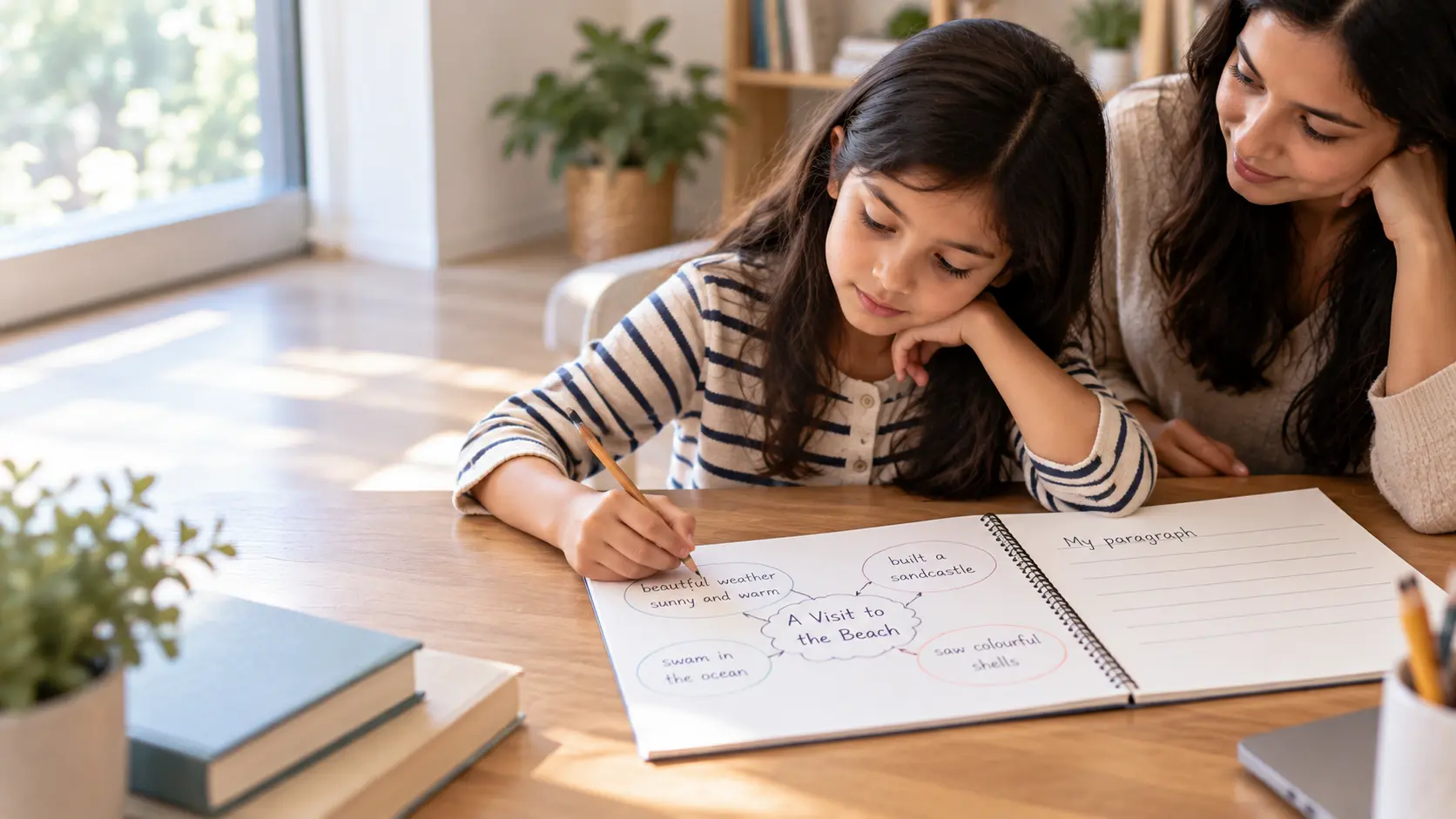
Before writing, ask: “What is this paragraph mainly about?” Keep the answer short enough to guide the writing. For example: “Why I like rainy days” is more useful than the very broad topic “Weather.”
Brainstorm more ideas than you need, then choose the details that genuinely support the focus. A plan can be as simple as three notes: cool air • puddles • reading by the window.
Let the child orally rehearse the main idea and details. Speaking first can reduce the simultaneous load of inventing content, organising it, spelling and handwriting.
The child may begin with a sentence that makes the focus clear, then add relevant details. A formal topic sentence is useful in many school tasks, but not every effective paragraph in every genre follows one identical formula.
Use pronouns, repeated key ideas, time words or connectives only when they help the reader see the relationship. Do not force first, next, then, finally into every paragraph when the ideas are not a sequence.
Ask whether every sentence belongs, whether anything important is missing and whether the order is easy to follow. Revision should improve meaning first; surface corrections can follow.
Guide section 04
Suppose the child writes: “I like rainy days. My dog is brown. I jump in puddles. The air feels cool. I read near the window.” Most sentences are grammatically possible, but one detail—My dog is brown—does not support the paragraph focus.
A clearer version might be: “I like rainy days because everything feels calm and cool. I enjoy jumping in puddles after the rain starts. Later, I like reading near the window while I listen to the water outside.” The paragraph is stronger not because it has more sentences, but because the details belong together and the relationships are clearer.
Guide section 05
A clear topic sentence is a useful teaching scaffold, especially in school informational or explanatory writing. It can help a child state the focus before adding supporting details. But it should not become a rule that every paragraph in every kind of writing must begin with one textbook-style sentence.
Narrative paragraphs, dialogue, descriptive passages and more advanced writing may organise information differently. Teach the underlying function—the reader should be able to understand what the paragraph is doing—then show how different genres achieve that function.
Guide section 06
Many children are told to “add more detail” and respond by adding any detail they can think of. Instead, ask whether the detail supports the main idea.
Guide section 07
Cohesion means the reader can follow how one sentence relates to the next. Children can build cohesion in several ways without repeating one connector formula.
For focused practice on beginner connectives, use Conjunctions for Kids. This paragraph guide stays focused on how relationships work across the whole paragraph.
Guide section 08
Not every paragraph needs a separate sentence that simply repeats the opening. A conclusion can be useful when it genuinely closes an explanation, opinion or section, but children should not be taught to add a redundant final sentence solely to satisfy a fixed count.
A better check is: Has the paragraph completed the job it started? Sometimes the final supporting detail is enough. Sometimes a brief closing sentence helps. The answer depends on purpose and genre.
Guide section 09
If the child can explain grammar rules but repeatedly loses them during fresh paragraphs, use My Child Knows Grammar Rules but Still Makes Mistakes. That is a transfer issue rather than a paragraph-structure issue alone.
Guide section 10
Give four sentences around one topic and add one unrelated sentence. Ask the child to remove the sentence that does not support the main idea and explain why.
Write three related details on separate cards. Let the child try different orders and decide which is clearest. There may be more than one reasonable order if the logic still works.
Give a simple focus such as “Why our class garden is useful” and brainstorm five details. Choose the strongest two or three before writing.
Ask the child to say the paragraph while looking only at a three-word plan. Then write it. Compare whether the written version kept the same focus and order.
On the first reread, ask only: Does every sentence belong? On another pass, check order and clarity. Punctuation and spelling can be reviewed separately so revision does not become a wall of corrections.
Guide section 11
Guide section 12
Evidence behind this guide
The IES/What Works Clearinghouse elementary-writing practice guide supports teaching children to use the writing process for different purposes and includes planning, organising ideas, sentence generation, evaluating and revising. Its examples include distinguishing main ideas from supporting details and ordering ideas. It does not prescribe one universal five-sentence paragraph formula.
The English national curriculum in England progressively expects children to plan, draft, evaluate and edit writing, organise material and use paragraphs as writing develops. Those expectations are useful curriculum context, but they are England-specific and should not be treated as universal age cut-offs for every learner.
IES / What Works Clearinghouse — Teaching Elementary School Students to Be Effective Writers
evidence-based recommendations on planning, organising, drafting, sentence construction, evaluating and revising writing.
Read sourceGOV.UK — National curriculum in England: English programmes of study
curriculum expectations for composition, organisation, paragraphs, grammar and editing across primary years.
Read sourceContinue from here
Parents also ask
Common questions parents ask about this topic
There is no universal number. The stronger goal is one clear main idea developed with enough relevant details for the reader to understand it. A short focused paragraph can be better than five repetitive sentences.
A topic sentence is a useful scaffold for many school explanations and informational tasks, but not every paragraph in every genre must begin in exactly the same way.
Paragraph writing adds planning, selection, ordering and cohesion. A child may form correct individual sentences but still need explicit support making those sentences work together around one focus.
Not necessarily. A closing sentence is useful when it genuinely completes the paragraph’s purpose, but it should not simply repeat the opening to satisfy a fixed formula.
Start with one clear focus, brainstorm and select a few relevant details, rehearse the paragraph aloud, write the sentences in a sensible order, then reread for relevance and clarity before correcting surface conventions.
About the Author

Founder & Academic Lead, Tiny Steps Learning
Priya leads Tiny Steps Learning's academic direction across phonics, reading, grammar, writing, and communication, including curriculum design, teacher guidance, and teaching quality.
Published 9 Sept 2026
Sources: 2 external source links cited in this article
Continue the learning path
These links follow the skill relationship for this topic rather than publication order.
When ideas are there but sentences are not clear yet
A free 35-minute 1:1 assessment can help identify whether your child needs support with core sentence structure, expansion, grammar accuracy or written transfer.