Quick answer: how can families practise public speaking at home?
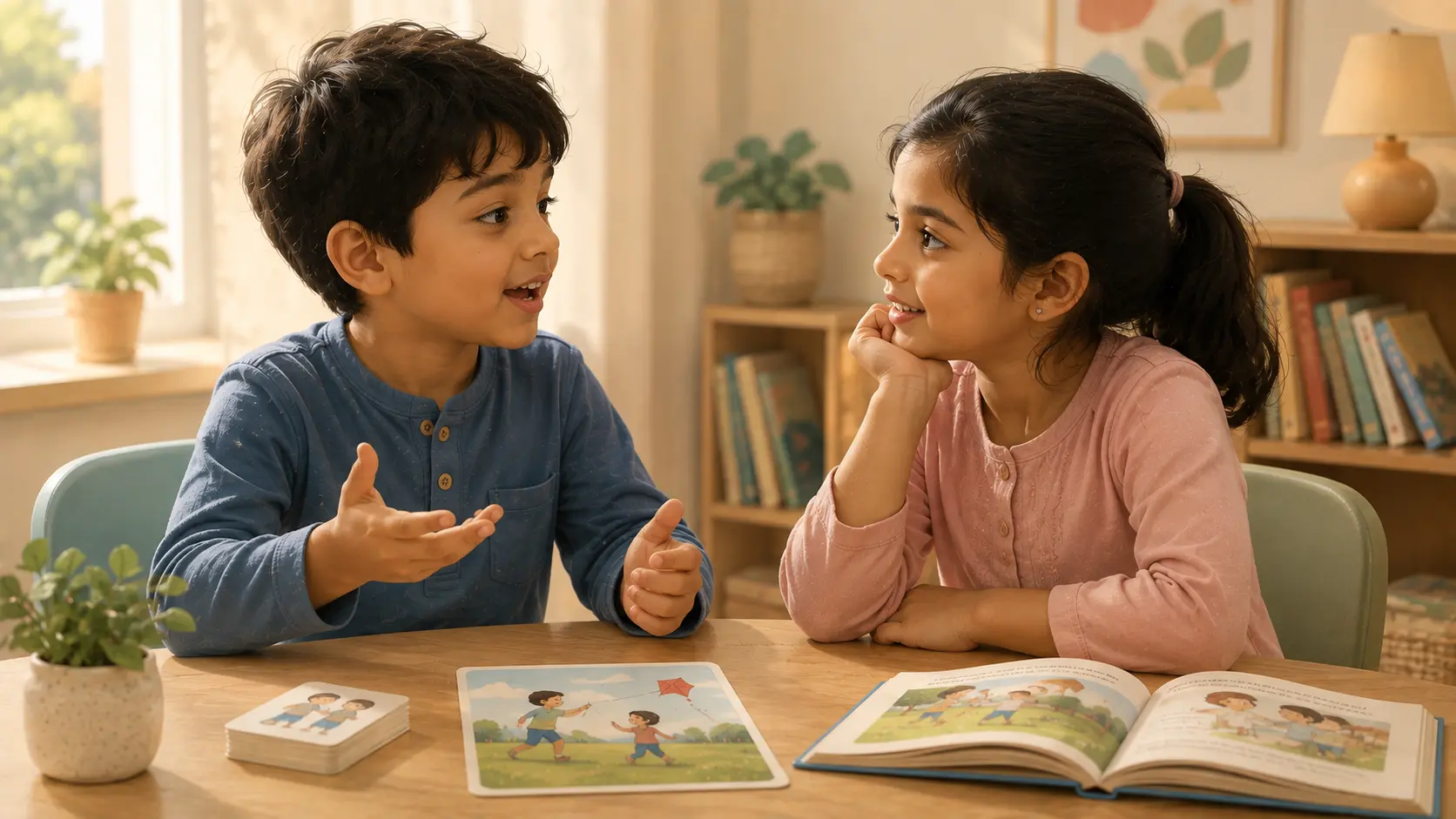
Create a **small, predictable speaking event with a real listener and a clear purpose**. A child might give a short talk, retell a story, explain how something works, interview a family member, use a picture or prop, answer questions, or co-present with someone else. Keep the audience respectful, make participation adjustable, and finish by noticing what communicated well and choosing one useful next step.
A family showcase is only one way to create purposeful speaking practice. It is **not a confidence treatment, a compulsory performance, or a test of personality**. If the main need is broader speaking confidence, use How to Build Speaking Confidence in Kids. For a planned speech, use How to Structure a Speech for Kids.
The Tiny Steps family showcase path: CHOOSE → PLAN → PRACTISE → HOST → LISTEN → FEEDBACK → REFLECT → REPEAT
- **CHOOSE:** select a speaking activity and participation level that fits the child.
- **PLAN:** decide the purpose, topic, audience, time and any permitted notes or visuals.
- **PRACTISE:** rehearse the difficult part or one target instead of drilling the whole performance repeatedly.
- **HOST:** create a simple event with clear turns and audience expectations.
- **LISTEN:** audience members listen for meaning rather than waiting to judge delivery.
- **FEEDBACK:** name one specific strength and, when useful, one actionable next step.
- **REFLECT:** let the child identify what felt easier, harder or more successful.
- **REPEAT:** reuse the skill on a fresh topic or with a slightly different audience when the child is ready.
A family showcase does not require every child to give a formal speech
Public speaking practice can include many kinds of purposeful spoken language. A child can explain, describe, retell, persuade, interview, answer questions, demonstrate, narrate or introduce another speaker. Formal speeches are useful for some goals, but they are not the only valid speaking activity.
This matters because the speaking demand should match the skill being practised. A child working on complete answers may benefit from an interview. A child working on sequence may retell an event. A child working on planned presentation can use a short Hook → Body → Conclusion structure.
Start by choosing the skill, not the performance
Before choosing a topic, decide what the child is practising. One showcase should not try to fix vocabulary, grammar, structure, volume, pace, gestures, eye contact and confidence all at once. A clearer goal makes the activity easier to plan and the feedback more useful.
- **Starting independently:** begin without the parent supplying the first sentence.
- **Expanding an answer:** add a reason, example or useful detail.
- **Sequencing:** explain what happened first, next and finally.
- **Speech organisation:** open clearly, develop the main ideas and finish purposefully.
- **Audience explanation:** make a picture, object, demonstration or idea understandable to someone else.
- **Listening and response:** hear another person and ask or answer a relevant question.
- **Delivery:** work on one feature such as audibility, pace or pausing when it is genuinely limiting communication.
15 public speaking activities for kids at home
1. Show and explain
Choose one object and explain **what it is, why it matters and one detail the audience may not know**. This is stronger than simply holding up a favourite toy and naming it.
2. Picture talk
Use a photograph or illustration. Describe what is visible, infer what may be happening, and explain one detail that supports the idea. For younger children, one or two complete sentences can be enough.
3. Story retell
Retell a familiar story, outing or event using an understandable sequence. The goal is not word-for-word memorisation; it is organising important information so another person can follow it.
4. How-to demonstration
Explain a simple process such as folding a paper plane, making a bookmark or caring for a plant. The audience should be able to understand the steps from the child’s explanation.
5. Book recommendation
Share the title, one spoiler-free idea about the book, what the child liked or questioned, and who might enjoy it. This combines explanation with opinion and evidence.
6. Mini news report
Report a family-safe event, school activity, weather observation or invented classroom news item. Ask the child to answer **what happened, where, when and why it matters**.
7. Family interview
The child prepares three or four questions for a relative, listens to the answers and asks one relevant follow-up. This practises speaking and listening rather than turning every activity into a monologue.
8. Two-person presentation
Two children or a child and adult divide a topic into parts, introduce each other and hand over smoothly. Co-presenting can reduce the speaking load while still requiring preparation and audience awareness.
9. One-minute opinion
Choose a low-stakes question such as “Should every classroom have a reading corner?” Give a position, reason and example. For deeper argument-and-response work, use the debate starters guide.
10. Visual-aid explanation
Use a picture, simple chart, map or object only when it helps the audience understand the message. The child should show it, explain what to notice and then reconnect with the audience. See How Kids Can Use Visual Aids in Public Speaking.
11. Mystery object clues
Hide or cover an object and give increasingly useful clues without naming it. This practises precise description, audience monitoring and flexible wording.
12. Teach me something
Ask the child to teach a family member one fact, skill, game rule or school concept they understand. The audience can ask one question afterward to check whether the explanation was clear.
13. Character or role interview
One person becomes a book character, scientist, explorer or invented figure while another asks questions. The child has to listen and respond without relying on a memorised speech.
14. Story-card talk
Choose character, setting and event prompts, then build a short connected story orally. The full story-card grammar and speaking guide explains how to fade prompts gradually.
15. Host or emcee role
A child who does not want a longer solo performance can welcome the audience, introduce speakers, announce the next activity and close the event. Hosting is genuine audience-facing communication and can be a useful participation role.
Participation can be adjusted without pretending every step is equivalent
A showcase should create an achievable next challenge, not force the largest possible audience. A child who is ready for a solo two-minute talk has a different goal from a child who is practising one complete answer to one trusted adult. Both can participate, but the parent should record what level of support was needed rather than calling every attempt “the same confidence milestone.”
Possible participation levels
- **Level 1:** answer one prepared question to one trusted listener.
- **Level 2:** share one or two sentences using a picture, object or sentence starter.
- **Level 3:** retell, explain or present for a short period to a small familiar audience.
- **Level 4:** co-present, host, answer follow-up questions or speak on a fresh but familiar topic.
- **Level 5:** deliver a more independent planned talk and adapt to audience questions or small changes.
These are Tiny Steps teaching levels for planning practice, **not clinical, developmental or standardised assessment levels**.
How to plan a simple family showcase
- **Choose the purpose:** practise one speaking skill, celebrate a project, share a story or simply create a listening-and-speaking routine.
- **Choose participants:** child alone, siblings, parent-child pair, grandparents or a small online audience.
- **Choose activities:** mix formats if useful so every child does not need the same performance.
- **Set approximate length:** keep the event short enough that the audience can listen attentively. There is no universal two-minute-per-child rule.
- **Assign roles:** speaker, host, interviewer, timekeeper, visual helper or audience questioner.
- **Set audience rules:** listen, do not interrupt, do not laugh at mistakes, and give feedback only in the agreed format.
- **Check technology:** for video calls, test the device, microphone and connection and decide who controls mute/unmute.
A flexible showcase flow parents can copy
- **Welcome — 2 minutes:** host explains the order and the audience rule.
- **Warm-up — optional 2–3 minutes:** one easy family question or voice warm-up if it helps participants settle.
- **Speaking activities — 10–25 minutes:** each participant completes the chosen task. Adjust length to age, number of speakers and attention span.
- **Questions — optional:** one relevant audience question after selected activities.
- **Feedback — 3–5 minutes:** specific observations, not a public list of faults.
- **Reflection — 2 minutes:** each child can name what they liked, what felt difficult or what they want to try next.
This is a planning example, not a required schedule. A five-minute showcase with one child can be completely appropriate. So can a longer family evening when several people genuinely want to participate.
Audience rules matter as much as speaker practice
A supportive audience does more than clap. It listens for the message, waits for the speaker to finish, asks relevant questions and avoids turning a mistake into entertainment. Family members should know the feedback rule **before** the event begins.
- Do not interrupt to correct grammar or pronunciation while the child is speaking unless the activity specifically requires immediate coaching.
- Do not compare siblings, cousins or previous performances publicly.
- Do not demand louder applause as proof that a performance was successful.
- Ask questions about the content rather than only commenting on appearance or cuteness.
- Keep jokes away from mistakes, accents, hesitations or language differences.
Use feedback that helps the next attempt
“Amazing!” can feel encouraging, but it does not tell the child what worked. A stronger feedback structure is **NOTICE → EFFECT → NEXT**. Name one observable behaviour, explain how it helped the listener, then add one small next step only if another attempt is planned.
- **NOTICE:** “You gave the example after your main point.”
- **EFFECT:** “That helped me understand why you recommended the book.”
- **NEXT:** “Next time, try the same structure on a book I have not heard about.”
If the child is using a recording for self-review, use How Video Feedback Helps Kids Improve Public Speaking. Recording is optional; live feedback is enough when video would add unnecessary self-consciousness.
Should parents correct children during the showcase?
Usually, let the child finish the speaking turn. If the purpose is communication, repeated interruption can shift attention away from the message. Afterward, choose feedback connected to the target. If the showcase is specifically practising a language form, a brief model-and-retry can be useful—but that should be agreed in advance rather than sprung on the child mid-performance.
The event itself can therefore be mostly celebratory while still allowing useful learning afterward. “No corrections during the performance” is a sensible default for many families, but **“never give corrective feedback” is not the goal**.
How to include children who do not want a solo performance
A reluctant child should not automatically be pushed into the longest solo task because the event is called a showcase. Offer a meaningful smaller role: co-present, ask prepared questions, introduce another speaker, explain one visual, give one sentence, or participate with one trusted adult. Increase the speaking demand only when the next step is achievable and useful.
If a child understands English but is persistently unable to speak in particular settings, use the narrower guide My Child Understands English but Does Not Speak in Class. If replies remain one word even in comfortable settings, use My Child Gives Only One-Word Answers.
Video-call family showcases: keep privacy and participation simple
- Invite only the people needed for the activity rather than creating a very large audience by default.
- Tell guests whether the session may be recorded. Do not assume attendance equals consent to recording or sharing.
- Avoid posting a child’s practice or performance publicly unless the parent has deliberately made that separate privacy decision.
- Use speaker view/full-screen only if it helps the child; technology should not become an extra performance test.
- Have a backup plan if the connection fails: continue with the people physically present or reschedule instead of making the child wait under pressure.
Do you need props, costumes, certificates or prizes?
No. Props and visuals are useful only when they support the message. Costumes may fit dramatic reading or role-play but are unnecessary for ordinary speaking practice. Certificates and small celebrations are optional family choices, not ingredients required for learning.
If you do use a certificate, praise something observable rather than a fixed trait. For example: **“For explaining your science model in a clear sequence and answering two questions independently.”** This tells the child what skill the family actually noticed.
Should a family showcase happen every week or every month?
There is no evidence-based universal frequency for family showcase nights. Repeat the activity when it serves a real learning purpose and the family can keep it manageable. Some children may benefit from frequent short speaking turns; others may use a larger showcase only occasionally while practising conversation, retelling or classroom-style responses in between.
Progress should come from **appropriate repeated speaking opportunities**, not from forcing a calendar tradition after it stops being useful.
How to tell whether the showcase is helping
- The child starts with less adult wording or prompting.
- Ideas become easier for listeners to follow.
- The child adds relevant details, reasons or examples more independently.
- The child can answer a simple follow-up without returning to a memorised script.
- A skill practised with family begins to appear with a fresh topic, listener or setting.
- The child can identify one thing that worked and one realistic next step.
Applause, smiles and willingness to participate can be pleasant parts of the event, but they are **not enough on their own to prove speaking progress**.
What parents should avoid
- Do not turn every family gathering into a surprise performance request.
- Do not write every sentence and then judge the child on how perfectly it was memorised.
- Do not correct every grammar, pronunciation and delivery feature in one feedback round.
- Do not compare one child’s volume, confidence or fluency with a sibling or cousin.
- Do not require video, costumes, props or certificates when they do not support the learning goal.
- Do not use “shy” as a permanent label when describing the child to the audience.
Choose the right next speaking guide
- Speaking confidence roadmap — for broader independence and gradual audience practice.
- Speech structure — when the child needs help organising a planned talk.
- Visual aids — when a picture, chart, prop or slide should support the message.
- Debate starters — for opinions, reasons, listening and respectful response.
- Video feedback — for optional one-target review and retry.
- Competition preparation — for formal event rules, timing, rehearsal and logistics.
- Explore the Tiny Steps speaking programme
- See how speaking fits into the broader learning pathway
Evidence behind the approach
The English National Curriculum expects pupils to develop competence in spoken language, participate in discussions, presentations, performances, role play and debate, and adapt communication for different audiences and purposes. Source: https://www.gov.uk/government/publications/national-curriculum-in-england-english-programmes-of-study/national-curriculum-in-england-english-programmes-of-study
The Education Endowment Foundation’s oral-language evidence supports purposeful spoken interaction, discussion, modelling and structured opportunities to use language. The EEF also notes that its evidence base is broader oral-language practice rather than proof that one specific public-speaking activity or showcase format is superior. Source: https://educationendowmentfoundation.org.uk/education-evidence/teaching-learning-toolkit/oral-language-interventions
EEF feedback guidance emphasises feedback that is connected to the learning goal and gives learners information they can act on. That principle supports specific post-showcase observations more strongly than vague praise or a public list of faults. Source: https://educationendowmentfoundation.org.uk/education-evidence/guidance-reports/feedback
India’s Learning Outcomes at the Elementary Stage emphasise meaningful listening and speaking, participation in conversations, asking and responding to questions, and communicating ideas in context. Source: https://www.education.gov.in/sites/upload_files/mhrd/files/Learning_outcomes.pdf
The **CHOOSE → PLAN → PRACTISE → HOST → LISTEN → FEEDBACK → REFLECT → REPEAT** sequence, participation levels and activity formats in this article are Tiny Steps editorial teaching scaffolds. They organise the broader principles above; they are not presented as a standardised or clinically validated family-showcase programme.
Tiny Steps parent takeaway
The strongest family showcase is not necessarily the biggest or most polished one. It is the one where the child has a clear communication goal, an achievable speaking role, listeners who pay attention to meaning, and feedback that makes the next attempt more independent. **Create a real reason to speak, then keep the event small enough that the speaking skill—not the spectacle—stays central.**