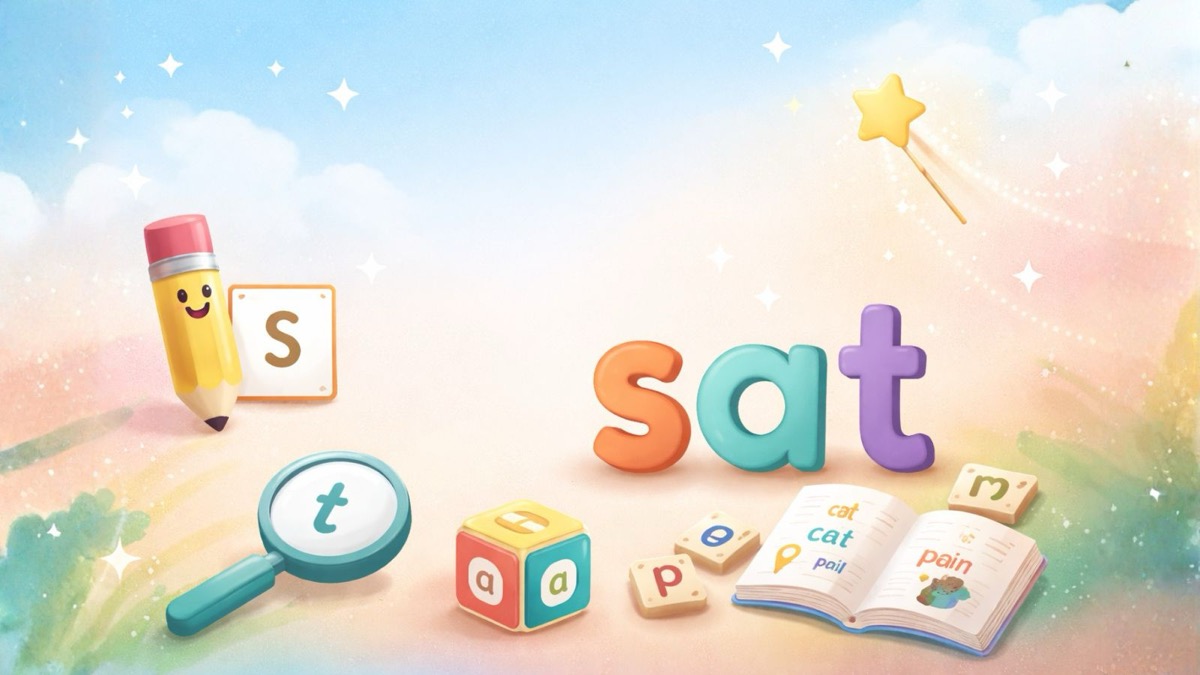
What “SATPIN” means (and why it’s a smart first set)
SATPIN is six simple sounds: s, a, t, p, i, n. These letters combine to make dozens of simple three-letter (CVC) words like sat, pin, tap, and tin.
We choose SATPIN first because the letters are distinct, their sounds are easy to say, and they form many early words. For busy parents and short attention spans, this set gives quick wins.
Letter names vs letter sounds (the common confusion)
Many children know the ABC song and can say “bee” or “see.” But reading needs the speech sounds those letters make: /b/ /s/ /t/ etc. Saying the letter name (“bee”) is not the same as saying the sound /b/ used in decoding.
So the first job is to teach the sound, not the name. Use lowercase letters from storybooks — that’s what children see in real reading.
The Week 1 plan (7 days, 10 minutes/day)
Each day: warm-up (1 min), teach/practice (6–7 min), celebrate & stop (1–2 min). Keep sessions playful and routine-based so your child knows what to expect.
Day 1 — s, a
Introduce /s/ and /a/. Show the letters, say the sound, let your child repeat, then trace each letter once with a finger.
Example words to say: sat, pat. Success: child says /s/ and /a/ when you show the letters.
Day 2 — t, p
Introduce /t/ and /p/. Play a quick I-Spy: “I spy something that starts with /t/.” Trace and tap as you say each sound.
Example words: tap, pat. Success: child identifies the initial sound in a spoken word.
Day 3 — i, n
Introduce /i/ and /n/. Use a motion (e.g., point to tummy for /i/ like “it”) and a nose touch for /n/ so learning is multisensory.
Example words: pin, tin. Success: child repeats sounds and traces letters.
Day 4 — Review + blend a few words
Quickly review all six sounds, then demonstrate blending for one word: /s/ /a/ /t/ → “sat.” Let your child try with support.
Example words: sat, pat. Success: child blends one word with prompting.
Day 5 — More blending practice
Blend two or three CVC words together. Use letter cards or toys as markers for each sound.
Example words: sat, pat, pin. Success: child blends independently or with minimal help.
Day 6 — Little reading practice
Read a very short decodable sentence using learned words: “Pat sat.” Point to each word and blend as you go.
Success: child recognizes at least one word when you point and sound it out.
Day 7 — Game day + celebrate
Play quick sound games (see below), then review any words your child found tricky. Give a small reward — a sticker or a thumbs-up — and end on a positive note.
Games that work (no worksheets needed)
Short, playful games are best for LKG/UKG and early primary. Here are quick options you can use in 1–3 minutes each.
- I Spy Sounds — spot initial sounds around the room.
- Sound Clap — say a CVC word and clap for each sound.
- Toy Match — place three toys and ask which one starts with /p/.
- Letter Trace Race — trace a letter in the air with a finger, add silly sound effects.
- Sound Hop — place cards on the floor and let your child hop to the card after you say a sound.
- Blend Basket — put letter cards in a basket and pull three to blend aloud.
SATPIN example bank (ready-to-use for busy parents)
Use these examples as-is so practice is quick and predictable. Do one mini set per day and repeat it twice.
- Set A: sat, pat, tap. Sentence: "Pat sat." "Tap, tap."
- Set B: pin, tin, nip. Sentence: "Pin it." "Tin can."
- Set C: pan, tan, nap. Sentence: "Tan pan." "Nap in pan."
- Mixed review: sat, pin, tap, tan, nip. Ask child to sort by middle vowel /a/ vs /i/.
- Parent prompt: "Show me each sound first, then blend." If stuck, return to slow blend and retry once.
If your child reads one full sentence independently from these sets, count that as a strong daily win.
Blending: when to start (and how to do it without pressure)
Start blending once your child can hear and say 4–6 sounds reliably. Blending should be short and supported: you say the sounds, then say them faster to make the word.
Use gestures: stretch sounds slowly (/s—a—t/) then snap to “sat.” Praise effort and try again another day if it’s not clicking.
Mistakes to avoid (and what to do instead)
Avoid long worksheets, timed drills, or pushing too many letters at once. These create frustration and turn sessions into homework.
Do instead: short play-based practice, one new sound at a time, clear praise, and immediate positive feedback. If you notice confusion, slow down and revisit sounds with games.
Troubleshooting
If my child mixes sounds (b/d or p/q)
Use multi-sensory cues — say the sound, trace, and add a small action. For b/d confusion, try a “bat” vs “dog” gesture so shapes and sounds link to movement.
If my child can’t blend yet
Return to phonemic awareness games. Clap sounds, segment words, and slow the pace. Blending often follows with a little more practice.
If my child gets bored
Switch to a 1‑minute game, sing the sounds, or try a toy-based activity. Always end on a win.
Signs Week 1 is “done” (simple checklist)
- Can say 4–6 SATPIN sounds when prompted.
- Can blend at least one CVC word with support.
- Enjoys short, 5–10 minute sessions and asks to play again.
What to do in Week 2 (teaser + next step)
Week 2 builds on blending: we add two more sounds, increase blending practice, and introduce short decodable books. The aim is fluent decoding of many CVC words by the end of the fortnight.
If you want guided lessons and a clear progression, Tiny Steps has a structured Phonics program with lesson-by-lesson milestones.
Try this next: pick 3 CVC words your child liked this week and practise blending them twice a day for three days.
Parent guide: how to use this weekly plan in real life
Use this weekly post as a practical checklist, not a one-time read. Keep routines short, repeat the same target for 5-7 days, and track one visible win.
- Choose one daily slot and keep it fixed (same time, same place).
- Do 10-15 focused minutes only; stop while your child still feels successful.
- Use one correction script: "Let us try slowly, then fast."
- Send one weekly note to the teacher: what improved, what still needs support.
Research basis: why this weekly plan works
This weekly structure reflects evidence-aligned classroom practice used in early literacy and communication instruction: explicit teaching, short retrieval cycles, and repeated guided practice with feedback.
- Distributed practice beats cramming: short sessions across the week improve retention better than one long session.
- Retrieval and correction loops build fluency: recall first, then immediate gentle correction, then one successful retry.
- Clear success criteria improve motivation: children engage better when the goal is visible and achievable in one session.
Tiny Steps quality standard for this week
Every Tiny Steps weekly blog should give parents a usable routine, measurable progress signal, and practical fallback when the child gets stuck. Use this page as a field guide, not theory-only reading.
- One concrete routine parents can run in 10-15 minutes.
- One measurable checkpoint (accuracy, fluency, or confidence) by week-end.
- One rescue strategy for low-motivation days so consistency does not break.
Real-world action plan: SATPIN without overwhelm
Do not start with heavy worksheets. Start with clear sound production, oral blending, and short decodable lines children can actually read.
10-minute at-home routine (realistic for busy parents)
- Day 1-2: Teach s, a, t with pure sounds. Ask for sound in under 2 seconds using flash cards.
- Day 3-4: Add p, i, n and blend sat, pin, tap, tin with finger taps.
- Day 5-7: Read 4 tiny lines like "Sam sat." and "Pat taps." Keep each session to 10 minutes.
If your child gets stuck
If your child says letter names instead of sounds, model once, ask for echo twice, then return to one simple blend. If frustration rises, switch to oral-only blending for 2 minutes.
End-of-week success signs
- Child recalls all six SATPIN sounds quickly.
- Child blends at least five CVC words without picture guessing.
- Child reads one short decodable sentence with support.
Parents also ask this week
- My child forgets sounds the next day. Start every session with a 90-second sound review before new words.
- My child mixes b and d. Delay these letters for now and return after sound confidence is stable.