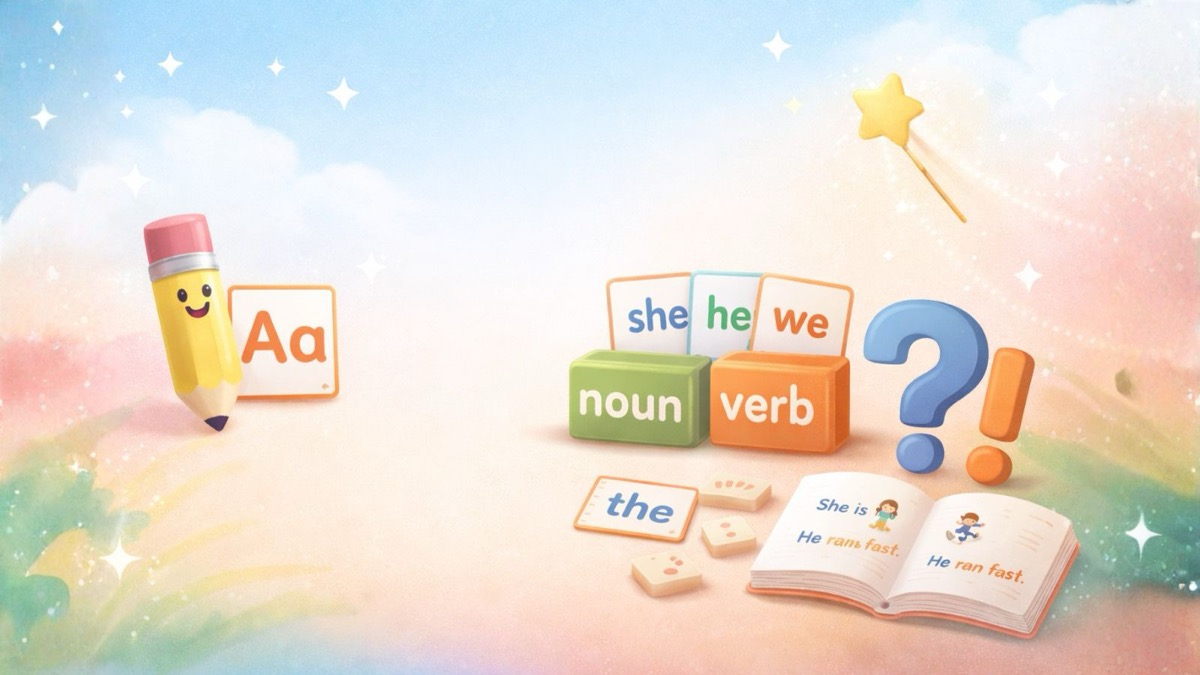
Parent question: "How can I check my child’s grammar level without pressure?"
Direct answer: use a short, low-pressure grammar check to find one or two specific gaps, then practise only those gaps. This gives clearer progress than correcting everything at once.
What this usually means for parents
When grammar feels inconsistent, the issue is often not effort. Children usually need targeted practice in one weak layer such as sentence boundaries, tense control, or paragraph structure. A quick assessment helps you pick the right layer first.
Why quick assessments help (plan smarter, reduce nagging)
Quick, playful assessments show you what to practise next — without turning every mistake into a lecture. When parents know a small, specific gap (for example, tenses or punctuation), they can plan short practice bursts instead of repeated corrections. Assessments free you from guessing, reduce nagging, and make learning feel like a series of small wins.
The 15-minute home assessment (how to set the mood)
Keep the mood calm and game-like. Choose a quiet 15 minutes, remove screens, offer a small snack, and frame it as “a quick check to see how we can help.” Use a timer, keep your tone warm, and tell your child you will celebrate effort. The aim is information, not judgment.
Nouns/verbs/adjectives quick checks (simple tasks)
Task 1 — Naming game: Ask your child to name five things in the room and tell you one word to describe each (adjective). Task 2 — Action swap: Give a photo and ask “What is happening?” to elicit a verb. Tick whether they can label the noun, verb, and an adjective for each prompt.
Tenses + punctuation checks (mini prompts)
Prompt 1 — Tense check: Say a short sentence in present (“She eats”) and ask your child to say it in the past and future. Prompt 2 — Punctuation quick-fix: Give a short two-line paragraph with missing punctuation and ask them to add full stops and capitals. Keep each prompt to one minute.
Paragraph check (4-sentence frame test)
Ask your child to write or tell a four-sentence mini-paragraph: 1) Topic sentence, 2) Two detail sentences, 3) Closing sentence. Use this to check sentence structure, tense consistency, and punctuation. For speaking versions, record or note whether they used linking words (and, because, but).
Week 17 plan (7 days, 10 minutes/day): assess → fix → reassess
A gentle rhythm helps correct small issues quickly. Day 1 assess, Days 2–3 target practice, Day 4 mini reassess, Days 5–6 repeat practice, Day 7 final check and celebrate.
Day-by-day (exact)
- Day 1 — 15-minute assessment: run the 15-minute home assessment using the script below.
- Day 2 — Target practice (10 min): Pick one skill (e.g., past tense) and practise with 5 quick prompts.
- Day 3 — Target practice (10 min): Continue with short games that focus on the same skill.
- Day 4 — Mini reassess (10 min): Quick check of 3 items from Day 1.
- Day 5 — Practice with reading (10 min): Choose a short paragraph and highlight target forms.
- Day 6 — Fun review (10 min): Play a grammar game (sentence scramble or role-play).
- Day 7 — Final check & praise (10 min): One quick reassess and a celebration of progress.
Red/Amber/Green scoring method (easy for parents)
Use three simple labels to record results: Green = confident, Amber = needs practice, Red = target for instruction. For example, mark nouns as Green, verbs Amber, tenses Red. This gives a clear visual snapshot and helps you decide which two small targets to work on for the next four weeks.
What to do with results (focus plan for next 4 weeks)
Turn results into a tiny plan: pick two Amber/Red items, schedule 8–10 short (5–10 minute) practice moments across two weeks, then reassess. Use games and reading, not drills — parents can mix practice into daily routines like cooking or car time.
Done checklist + Week 18 video feedback teaser
- I ran a short 15-minute home assessment.
- I noted two focus items for practice.
- I scheduled short practice across the next week.
Finish by praising effort: “Thank you — you tried that really well.” Week 18 will show how video feedback can help notice small improvements.
Practical next step for parents
If the same grammar gaps remain after two focused practice cycles, move to a structured grammar pathway with level-based sentence and writing support.
- Explore the grammar learning path: /grammar
Ready-to-use parent script (read aloud)
“We will do a quick, fun check to see what to practise. No marks, just things to help us. I will read or show a short sentence and you can tell me or write your answer. Remember, this is practice — I will tell you one thing I liked at the end.”
Simple score sheet idea (no printing — use Notes app)
Create a note with three columns: Skill | R/A/G | Example. Under Skill list: Nouns, Verbs, Adjectives, Past tense, Punctuation, Paragraph. Tap to edit during the assessment and use a single line per skill. This is fast, portable, and searchable.
Gentle guidance for kids who get anxious
If a child seems nervous, pause and do a two-minute “breathing break” or a silly sound warm-up. Reassure them: “This is not a test — it shows what we can practise together.” Keep praise specific and quick, and let them choose a reward (sticker, choice of story) to end on a positive note.
Parent guide: how to use this weekly plan in real life
Use this weekly post as a practical checklist, not a one-time read. Keep routines short, repeat the same target for 5-7 days, and track one visible win.
- Choose one daily slot and keep it fixed (same time, same place).
- Do 10-15 focused minutes only; stop while your child still feels successful.
- Use one correction script: "Let us try slowly, then fast."
- Send one weekly note to the teacher: what improved, what still needs support.
Research basis: why this weekly plan works
This weekly structure reflects evidence-aligned classroom practice used in early literacy and communication instruction: explicit teaching, short retrieval cycles, and repeated guided practice with feedback.
- Distributed practice beats cramming: short sessions across the week improve retention better than one long session.
- Retrieval and correction loops build fluency: recall first, then immediate gentle correction, then one successful retry.
- Clear success criteria improve motivation: children engage better when the goal is visible and achievable in one session.
Tiny Steps quality standard for this week
Every Tiny Steps weekly blog should give parents a usable routine, measurable progress signal, and practical fallback when the child gets stuck. Use this page as a field guide, not theory-only reading.
- One concrete routine parents can run in 10-15 minutes.
- One measurable checkpoint (accuracy, fluency, or confidence) by week-end.
- One rescue strategy for low-motivation days so consistency does not break.
Real-world action plan: low-stress grammar assessment at home
Assessment should guide next teaching steps, not label the child. Keep checks short and skill-specific.
10-minute at-home routine (realistic for busy parents)
- Run three 5-minute checks: sentence correction, tense usage, and punctuation application.
- Mark with a simple rubric: green (secure), amber (needs practice), red (reteach).
- Choose only two amber/red targets for next week to avoid overload.
If your child gets stuck
If child gets anxious, call it a "checkpoint game," allow oral answers first, then convert to writing.
End-of-week success signs
- Parent gets a clear map of strengths and gaps.
- Child understands one to two priority targets for next week.
- Practice plan is based on evidence, not guesswork.
Parents also ask this week
- How often should I assess? Light weekly checks and a deeper check once every 4 weeks.
- Should I compare siblings? No, compare each child to their own previous baseline.