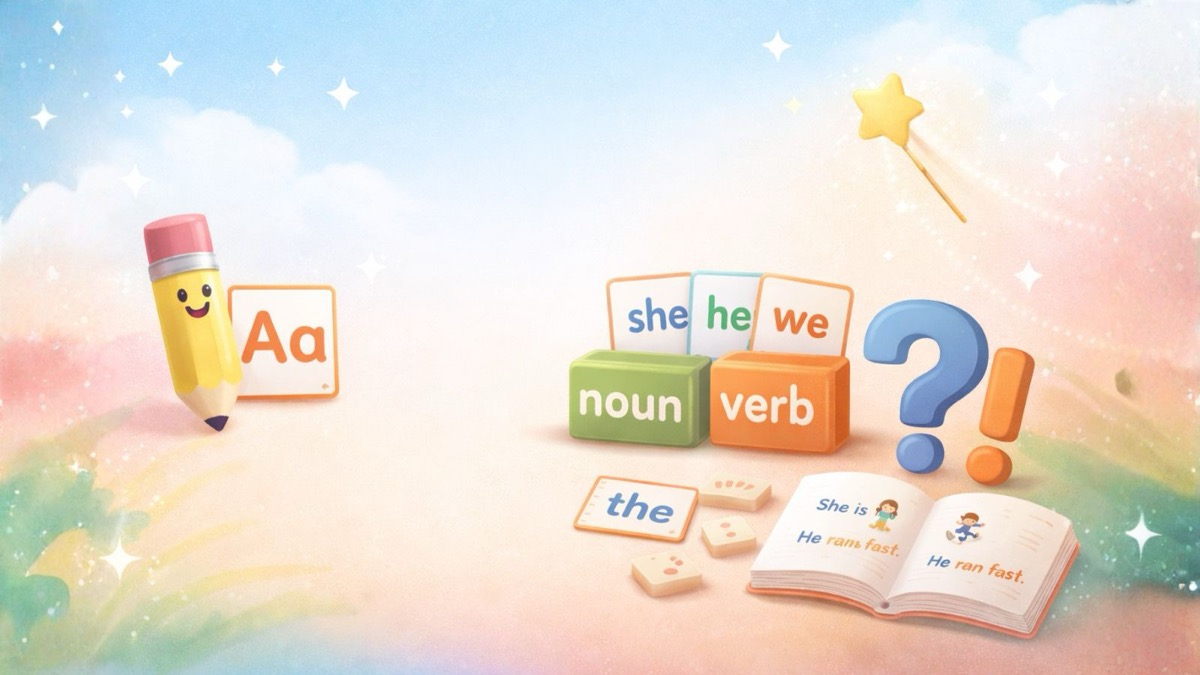
What is subject–verb agreement (SVA) in kid language
Subject–verb agreement simply means the doing word (verb) matches who is doing it (the subject). In child language: one person needs a different verb form than many people.
For example: “I run,” “He runs,” “They run.” The tiny change in the verb helps the sentence sound right and clear.
Note: this rule is for present tense everyday actions (e.g., He runs; She eats). Other tenses follow different patterns.
The single vs many rule (he/she/it vs they/we)
Teach a simple rule: if it is one person or thing (he/she/it), the verb often gets an extra sound (often an “s”). If it is many (they/we/you), the verb stays in its base form.
Use very short prompts: “One person — add S. Many people — no S.” Practise with toys: one doll vs two dolls.
The “S” trick for he/she/it (go/goes, play/plays) — keep exceptions simple
Explain: for he/she/it add an “s” to common verbs: go → goes, play → plays, eat → eats. Use the S as a tiny badge for single people.
Exceptions (be, have) are special: I am / He is; I have / She has. Teach these as special cards in the word bank rather than confusing rules.
Week 10 plan (7 days, 10 minutes/day)
Each day: warm-up (2 min), focused SVA practice (6 min), playful review (2 min). Use the 3‑wins rule: stop after three correct forms to build confidence.
Day 1 — Introduce stick figures + S badge
Draw a single stick figure and a group of stick figures. Show verb cards and practise: “He runs” (badge on single), “They run” (no badge).
Day 2 — Practice common verbs with S
Use play: “The monkey jumps” vs “The monkeys jump.” Swap one vs two toys to feel the change.
Day 3 — Special verbs day (be/have)
Teach quick cards for: I am / He is / They are and I have / She has / They have. Use chants to remember.
Day 4 — Sentence repair practice
Give incorrect sentences (“He are happy”) and ask your child to fix them using the stick figure cue.
Day 5 — Pronoun swap game
Swap pronouns in a sentence aloud and watch how the verb changes: “I play” → “He plays”.
Day 6 — Quick writing: fix the sentence
Do a 5‑minute “fix the sentence” with three lines to correct and two original sentences to write.
Day 7 — Share + celebrate
Child reads corrected sentences or their short writing to a family member. Praise effort and clarity.
Visual anchors: stick figures + verb cards (DIY)
Draw one stick figure for single, three small figures for many. Create a small red “S” sticker (or badge) you put near the single figure when the verb needs S.
Use laminated cards for verbs so children can place them under single or many and see the match.
Games (8–12): verb matching, sentence repair, S detective, pronoun swap
- S Detective — spot the missing S in a sentence.
- Pronoun Swap — swap cards and change the verb.
- Fix the Line — parent writes wrong sentence, child corrects.
- Badge Race — place S badges on correct verbs.
- Memory Match — match pronoun cards to verb forms.
- Role Play — act a scene and narrate with correct verbs.
- Quick Quiz — 3 cards shown, child says correct form.
- Sentence Jumble — reorder words and add correct S.
Common errors in Indian English context (he are, she have, they was) — gentle correction
These are frequent and normal. Correct gently with a question: “Let’s check — one person or many?” This helps the child self-correct rather than feel scolded.
Use modelling rather than repetition: repeat the correct sentence in a positive tone: “Yes — He is happy.”
Writing practice: 5‑minute daily “fix the sentence” + 2 original sentences
Quick routine: 1) Show 3 short wrong sentences to fix, 2) child writes 2 original sentences using taught pronouns and verbs. Keep feedback warm and specific.
Done checklist + Week 11 creative writing teaser
- Can use correct verb forms for he/she/it vs they/we in short sentences.
- Fixes three incorrect sentences in a quick check.
- Writes two short original sentences with correct SVA.
When ready, Week 11 focuses on creative writing scaffolds to extend ideas and use grammar for expression.
Quick reference table
- I am / He is / They are
- I have / She has / They have
- I go / He goes / They go
Parent scripts for corrections (“Let’s check: one person or many?”)
Script: “Let’s check — one person or many? If one, we add our little S badge: He plays. If many, we keep the verb: They play.”
Praise tip: say specifically: “Great — you added the S for he. Good listening!”
Parent guide: how to use this weekly plan in real life
Use this weekly post as a practical checklist, not a one-time read. Keep routines short, repeat the same target for 5-7 days, and track one visible win.
- Choose one daily slot and keep it fixed (same time, same place).
- Do 10-15 focused minutes only; stop while your child still feels successful.
- Use one correction script: "Let us try slowly, then fast."
- Send one weekly note to the teacher: what improved, what still needs support.
Research basis: why this weekly plan works
This weekly structure reflects evidence-aligned classroom practice used in early literacy and communication instruction: explicit teaching, short retrieval cycles, and repeated guided practice with feedback.
- Distributed practice beats cramming: short sessions across the week improve retention better than one long session.
- Retrieval and correction loops build fluency: recall first, then immediate gentle correction, then one successful retry.
- Clear success criteria improve motivation: children engage better when the goal is visible and achievable in one session.
Tiny Steps quality standard for this week
Every Tiny Steps weekly blog should give parents a usable routine, measurable progress signal, and practical fallback when the child gets stuck. Use this page as a field guide, not theory-only reading.
- One concrete routine parents can run in 10-15 minutes.
- One measurable checkpoint (accuracy, fluency, or confidence) by week-end.
- One rescue strategy for low-motivation days so consistency does not break.
Real-world action plan: fix subject-verb agreement errors
Agreement improves when children hear and compare pairs aloud: "He runs" versus "They run".
10-minute at-home routine (realistic for busy parents)
- Read pair cards daily: He runs/They run, She has/They have, It is/They are.
- Use action game: parent says subject, child says correct verb form while acting it.
- Write 5 short lines using mixed singular and plural subjects.
If your child gets stuck
If errors persist, isolate one pattern per day (is/are or has/have) and postpone less common patterns.
End-of-week success signs
- Child self-corrects common is/are and has/have mistakes.
- Child writes mixed singular/plural sentence sets accurately.
- Child reads own writing aloud and notices agreement issues.
Parents also ask this week
- Should I teach grammar terms first? No, pattern practice comes before terminology.
- My child says correct form but writes wrong form. Add quick dictation after oral drills.