Parent Tips

Are Phonics Apps Enough, or Does a Child Still Need a Teacher?

Are phonics apps enough for kids? A practical guide for parents on what apps do well, where teachers help more, and how to build early reading support.

Tiny Steps Academic Team2 May 20267 min read

Parents often search

  • Are phonics apps for kids useful if my child is just starting?
  • Can phonics games replace phonics classes for kids?
  • How do I know if my child is guessing instead of blending?
  • Are digital worksheets for kids effective for reading?

Best for

Real home routines

Built for families juggling reading, school, grammar, speaking, and screen-time decisions.

Use this when

You need the next right move

Helpful for busy parents who want a realistic plan they can use this week.

Next best route

Parents Help Hub

Use the broader parent guides when you want age-based routines and route-specific support.

Are Phonics Apps Enough, or Does a Child Still Need a Teacher?

Article snapshot

Quick answer

Phonics apps for kids can improve daily practice, but many children still need teacher feedback for blending, short vowels, pronunciation clarity, and reading confidence.

Category

Parent Tips

Best next move

Use the parent support hub for routines, progress guidance, and the most relevant next playbook.

Content ownership

Published by Tiny Steps Learning. This article is prepared by the Tiny Steps academic team to help parents make practical English-learning decisions.

Quick answer

Are Phonics Apps Enough, or Does a Child Still Need a Teacher?

Are phonics apps enough for kids? A practical guide for parents on what apps do well, where teachers help more, and how to build early reading support.

1. Quick Answer for Parents

Phonics apps can be very useful, but they are usually not enough on their own for every child. Most children do best with a mix of teacher guidance and app-based practice.

If your goal is early reading support, the right question is not "app or class?" but "which parts can an app handle, and where does my child need live feedback?"

2. What Phonics Apps Do Well

  • Make practice regular with short, repeatable sessions.
  • Keep children engaged through phonics games and rewards.
  • Provide quick revision of letter sounds and simple word patterns.
  • Help parents add structure when schedules are busy.

For many families, phonics apps for kids are a strong support tool, especially for revision between classes.

3. Where Apps Usually Fall Short

Apps often cannot observe subtle reading behaviors in real time. A child may tap the right answer but still decode weakly when reading aloud from a book.

  • Wrong sound pronunciation can go unnoticed without live correction.
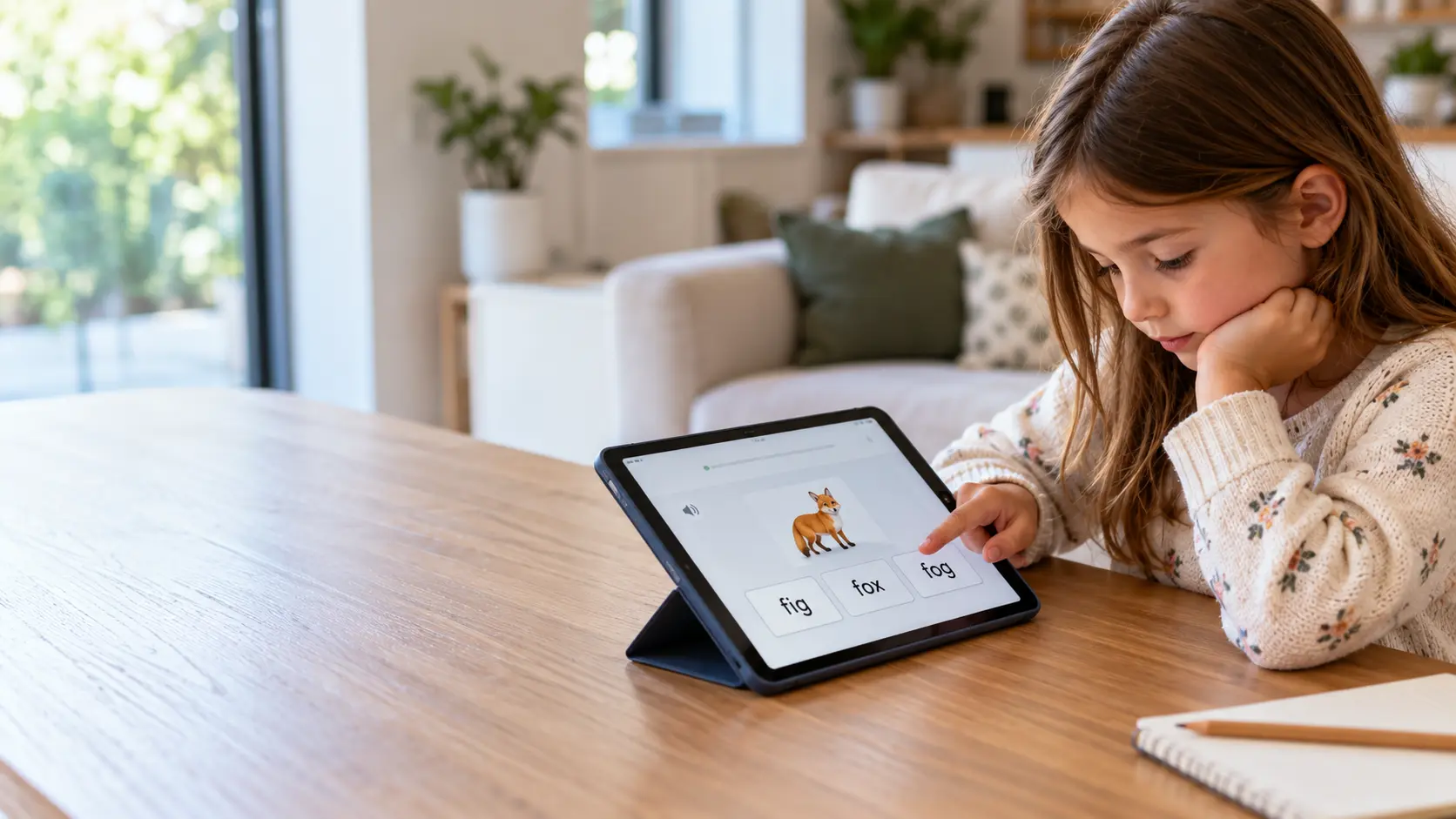
  • Children may guess words from pictures instead of blending sounds.
  • Short vowels are often skipped or swapped in connected reading.
  • Letter reversal confusion (b/d, p/q) may need targeted teacher cues.
  • Hesitation and confidence dips are easier for a teacher to spot early.

4. Why Teacher Feedback Matters in Early Reading

A good teacher listens to how a child reads, not only whether the child got an answer right. That difference is important in phonics classes for kids.

Teachers can adjust pacing based on readiness: slower when blending is unstable, faster when decoding is consistent. This prevents overload and builds steady confidence.

In online phonics classes, teacher feedback also helps parents understand exactly what to practice at home each week.

5. The Role of Digital Worksheets and Games

Digital worksheets for kids and game-based drills are useful when they reinforce a structured sequence. They work best as practice, not as the full learning plan.

When activities are random, children may enjoy the task but show limited transfer into actual reading. Sequence matters more than screen time.

6. The Best Model: Teacher-Led Learning + App-Based Practice

A balanced model is usually most effective: teacher-led instruction for diagnosis and correction, plus app practice for repetition and habit-building.

  • Teacher sets the weekly focus and corrects decoding errors.
  • App reinforces the same target through short daily review.
  • Parent tracks whether skills transfer to real reading at home.

7. Red Flags Parents Should Watch For

  • Child scores high in app tasks but avoids reading real words aloud.
  • Frequent guessing instead of sound-by-sound blending.
  • Ongoing short-vowel confusion after weeks of practice.
  • Confidence drops when child is asked to read without hints.
  • No clear progression path from basic sounds to sentence reading.

8. Practical Checklist Before Choosing an App or Class

  • Ask if the plan includes explicit blending instruction.
  • Ask how pronunciation errors are corrected in real time.
  • Ask how progress is measured beyond app scores.
  • Ask whether the content follows a stage-wise curriculum.
  • Ask what parent practice is expected each week.
  • Explore phonics pathway: /phonics
  • Compare starting routes: /courses
  • See full learning roadmap: /curriculum

9. Tiny Steps View

At Tiny Steps, we see apps as valuable practice partners, not replacements for thoughtful teaching. The strongest outcomes usually come from structured teacher-led progression plus focused daily reinforcement.

10. FAQ section with 5 parent questions

Parents also ask

Parents Also Ask

Common questions parents ask about this topic

Yes, they can help with routine, attention, and basic sound practice. Most children still benefit from teacher checks to ensure correct blending and pronunciation.

Continue with Tiny Steps learning paths

Turn this article into a clearer next step

When you are deciding the next step, use the course chooser and curriculum roadmap to match support to your child’s current need.

About the AuthorFoundations ForeverParent-first teaching
Priya, Founder of Tiny Steps Learning, early childhood English educator
Priya, Tiny Steps Founder

Tiny Steps Founder

Priya

With 10+ years of experience in early childhood English education, Priya founded Tiny Steps Learning to help children ages 3-12 build phonics, grammar, writing, and speaking confidence through calm, research-informed teaching.

Why this section matters

Tiny Steps content is built for families who need clear next steps, strong foundations, and realistic home routines.

Ages served

3-12 years

Focus areas

Phonics, grammar, speaking

Approach

Learning science + low-pressure routines

Editorial note

Every Tiny Steps guide is designed to reduce parent guesswork and turn teaching advice into small actions children can repeat with confidence.

Recommended Next for Parents

Looking for more structured support?

Explore our main programs, related guides, or compare courses directly.